

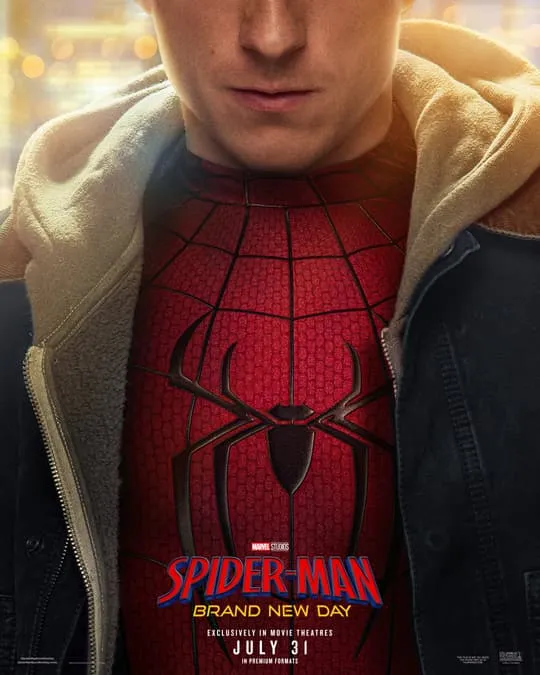

In the four years since the events of Spider-Man: No Way Home, Spider-Man has become the street-level hero that New Yorkers have needed and MCU fans have been waiting for. Though this hero’s star has risen, the man beneath the mask has all but disappeared, erased from the memories of his friends and allies by Dr. Strange’s spell. Perhaps due to the stress of loneliness, heartache, and the loss of personal identity, Peter Parker (Tom Holland) undergoes radical changes to his human-spider DNA. As if that weren’t enough, a new enemy emerges who knows Peter’s name and controls the minds of others, lashing out from behind their anonymous faces. Backed up by his anti-hero foil and temporary ally, the Punisher (Jon Bernthal), the Spider-Man finds a way to bring his elusive antagonist down and place her in the care of the Department of Damage Control. But has justice really been served?
Artful Action
Spider-Man’s distinct brand of super-heroics involves a marriage of nerdiness and acrobaticism, the latter giving material expression to the former. The ideal Spider-Man must be a clever dork, a guy accustomed to trouble-shooting and multitasking, solving complex problems while cracking lame jokes, perhaps doodling mazes or working ciphers on a napkin just for fun. It follows, then, that when Spider-Man slings his webs on film, he should pour every ounce of his nerd knowledge into the way he slings them.
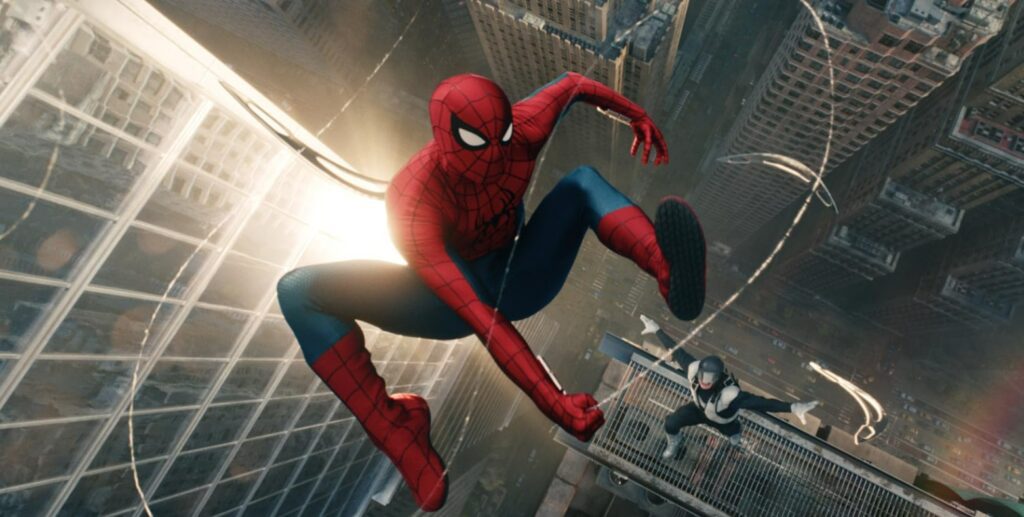
Director Destin Daniel Cretton understood the assignment. His Spider-Man is an instant engineer, a lord of leverage, a maestro of mechanical manipulation. And, though his physical feats are technically impossible, Cretton ensures that they are fascinating to watch. Spider-Man’s abilities have always been entertaining, but here there’s a logic to his web-based solutions, a cleverness and creativity that keeps you laser-focused on each maneuver.
Cretton and his team extended the same care to all the major set pieces, and even to smaller details. The Hand, a group of assassins, fights with such beautifully choreographed harmony that this reviewer muttered, “Whoa, that is cool!” in perfect but unplanned unison with Tom Holland’s character on screen. The primary antagonist’s mind-jumping power was choreographed to give a sense of sudden, violent motion that viewers feel even more distinctly than they hear the accompanying sound cue. The Hulk is appropriately huge and savage again, but Cretton suspends many tons of hanging masonry from his back to contextualize that strength and make it tangible and intuitive for viewers. One shot of a sliding Punisher firing from the ground wowed my entire (packed) theater. Even a brief sequence of Peter swinging a character home while broken-hearted shows an artist’s attention to detail in the frustrated, distracted way Peter fires off each strand. The physicality of Brand New Day, combined with its vibrant color palette and eye-popping cinematography, makes it a treat for the senses. But does its storytelling measure up to its visuals?
Parallelism, Pathos, and Plotting
Brand New Day juggles a lot of themes and drops only a few balls in the process. We aren’t shown what Peter does for a living—a rather important aspect of the Spider-Man character—and it’s also not clear how he maintains his secret at a crucial point late in the film. Perhaps these details ended up on the cutting-room floor of a film already bursting with plot and themes, but, given how well it balances these, the omissions get a pass from me.
As mentioned, Peter’s loneliness, the loss of his love MJ and his best friend Ned, the loss of his name/personal history, his struggle with a monster within, and his battle with a faceless external enemy are the main plot points driving the story. The film’s themes mirror those points, revolving around holding onto identity amid a shifting world that doesn’t know your name. As the film begins, Spider-Man is more of a person, in the fully social sense, than Peter Parker. The spider half is threatening to take over, while, paradoxically, the concealed enemy is also the only person who knows Peter’s true name and history. She’s also effectively a second main character, whose backstory, arc, and resolution must be worked into the film without distracting from Peter’s. That’s a lot to jam into one movie.
The writers pull it off by baking thematic parallelism into the plot. Spider-Man’s style of heroism is at tension with the Punisher’s, though they must work together. Peter’s human name and face are terribly anonymous, even as his hero-aspect is wildly popular. Peter’s internal monster with its out-of-control abilities echoes the monster within Bruce Banner, a character who also serves as more than a cameo. The film’s immediate antagonist may conceal a sympathetic character, while certain allies, affable on the outside, may be monstrous. I would love to mention another effective use of parallelism where a certain character’s gaze lingers on a mother and daughter in a public park, an interaction that pays off later in the film, but I cannot say more without tiptoeing into spoiler territory. I do want to highlight the cleverness of using a device, literally a physical McGuffin, to form a through-line connecting Bruce Banner, Peter Parker, the mystery antagonist’s character arcs, thus stitching the parallel themes together causatively.
Though Brand New Day is a long film stuffed with events, each event leads necessarily to the next, resulting in a story that is much tidier than it has any right to be. Is it perfect? Nothing is. But my family was mesmerized the whole way through, even when the third act was followed by a second third act. Both resolutions were necessary and engaging. While I don’t agree with critics who thought the film was overlong—who doesn’t want to get more movie for the price of one?—I do have a few small gripes.
MCU-Foolery
Lest audiences come away with the impression that this is just a Spider-Man film by Sony, Walt Disney would like to remind you that Brand New Day connects to the Marvel Cinematic Universe. Thus, we get a few scenes with Yelena Belova feeding Spidey essential information. Florence Pugh (Thunderbolts*, Oppenheimer, Dune 2) is always a welcome sight, and Yelena is a great character, but her description of Spider-Man’s problems as “little potato problems” in contrast with the New Avenger’s “big potato problems” was laughable, considering that Spider-Man could solo both post-Endgame Avengers teams (minus Sentry, of course) without breaking a sweat. This scene felt like a stolen valor moment, Kevin Feige’s desperate attempt to get audiences to regard his knock-off Avengers as warmly as they do Spider-Man. I should also mention that this scene features Yelena reclining in a large Russian-style bath, though nothing below her collar bone is visible in the clouded water. She insists that Spider-Man climb into the bath with her, since this is her office. He modestly keeps his compression shorts (and mask) on, and the moment is played for laughs, but it may merit a quick look-away for some viewers.
Another irritation was the incessant Iron Man-style jabbering from Spider-Man’s built-in AI assistant, E.V. The worst offense to storytelling occurs in a scene where Spidey is obviously undergoing massive sensory overload from his new powers, which E.V. helpfully elucidates for viewers by saying, “You are experiencing sensory overload.” Thank you, E.V/script notes from MCU Corporate and/or test audiences, but Destin Daniel Cretton already capably showed us what you now insist on telling us. Please say less.
A Tempest in a Telepath
This section contains a slight spoiler, but it seems necessary to address a controversy. A certain portion of the internet, those burned by the post-snap MCU and seemingly determined to stay angry, have taken exception to the main antagonist’s characterization and to her character’s arc. Since Sony and Disney concealed her character name in all lead-up marketing materials, any full rebuttal would reveal too much, but suffice to say that this character is a scarlet-haired telepath—as already revealed in the trailers. Let’s call her “Red.” Like Wanda Maximoff in WandaVision, Red does a lot of damage, only to escape consequences in the end. The internet’s two-fold complaint is that, a) Red is a beloved character who would never do the things she’s portrayed as doing in this film, and b) she gets off way too easily in the finale.
My answer to the first point is that this is a younger version of that character, one who (like Spider-Man) has been erased from human memory, and who has even fewer attachments or positive influences. Pushed to desperation by the need to right a great wrong, and completely without allies, she acts believably. Presumably, she’s not yet encountered her famous mentor, without whose formation few of her kind would have flown straight. This is Red pre-formation. We haven’t seen the finished product.
To the second objection, I reply that Red’s actions aren’t excused WandaVision-style: “They’ll never know what you sacrificed!” Rather she’s redeemed, and at the cost of blood. The evil she’s done is acknowledged, and she’s given an opportunity to change course. It’s also in the nature of superheroes to try to save the fallen, when possible. Black Widow, Rogue, Elektra, Silver Surfer, and many others came to heroism after a period of villainy, just as did multiple villains in Spider-Man: No Way Home. True, this particular future heroine did not start out as a villain in the comics, but Marvel is within its rights combining or appropriating other backstories to create a coherent character for this universe, provided that her portrayal in future films embodies the heroine fans deserve to see on screen.
The Web-Head Wins
Having hit the billion-dollar mark five days into its theatrical run (without IMAX screens!), there’s almost no doubt that Spider-Man: Brand New Day will win the 2026 box-office battle, but does it live up to the hype? I saw the movie with my whole family in a packed theater, and was thus able to observe the crowd reactions. The action was jaw-dropping. The jokes hit. The emotional beats were genuine. The dialog was snappy and character-accurate. Heck, for the first time ever, my family actually enjoyed Zendaya’s version of MJ. This film has moments that are genuinely sad, truly funny, refreshingly wholesome, and just plain cool. The emotional payoffs are hard-earned. The special effects, though no doubt making copious use of CGI, feel grounded and visceral in a way we haven’t seen in the MCU in some time. All of this evinces a great deal of thought and care on the part of director Destin Daniel Cretton and his team. In this age of expensive movie tickets, we’ve yet to take our children twice to the same movie, but we’ll be shelling-out to see this one again, hopefully in IMAX. No comic film will satisfy every fan, but our theater’s spontaneous applause as the credits rolled testify to a shared opinion: Spider-Man: Brand New Day rocks!
Content Warning: In addition to the aforementioned bath scene, parents should be aware that Jon Bernthal’s Punisher frequently swears and cusses, including multiple uses of “G*d*mn” and one web-suppressed attempt at a four-letter word.