

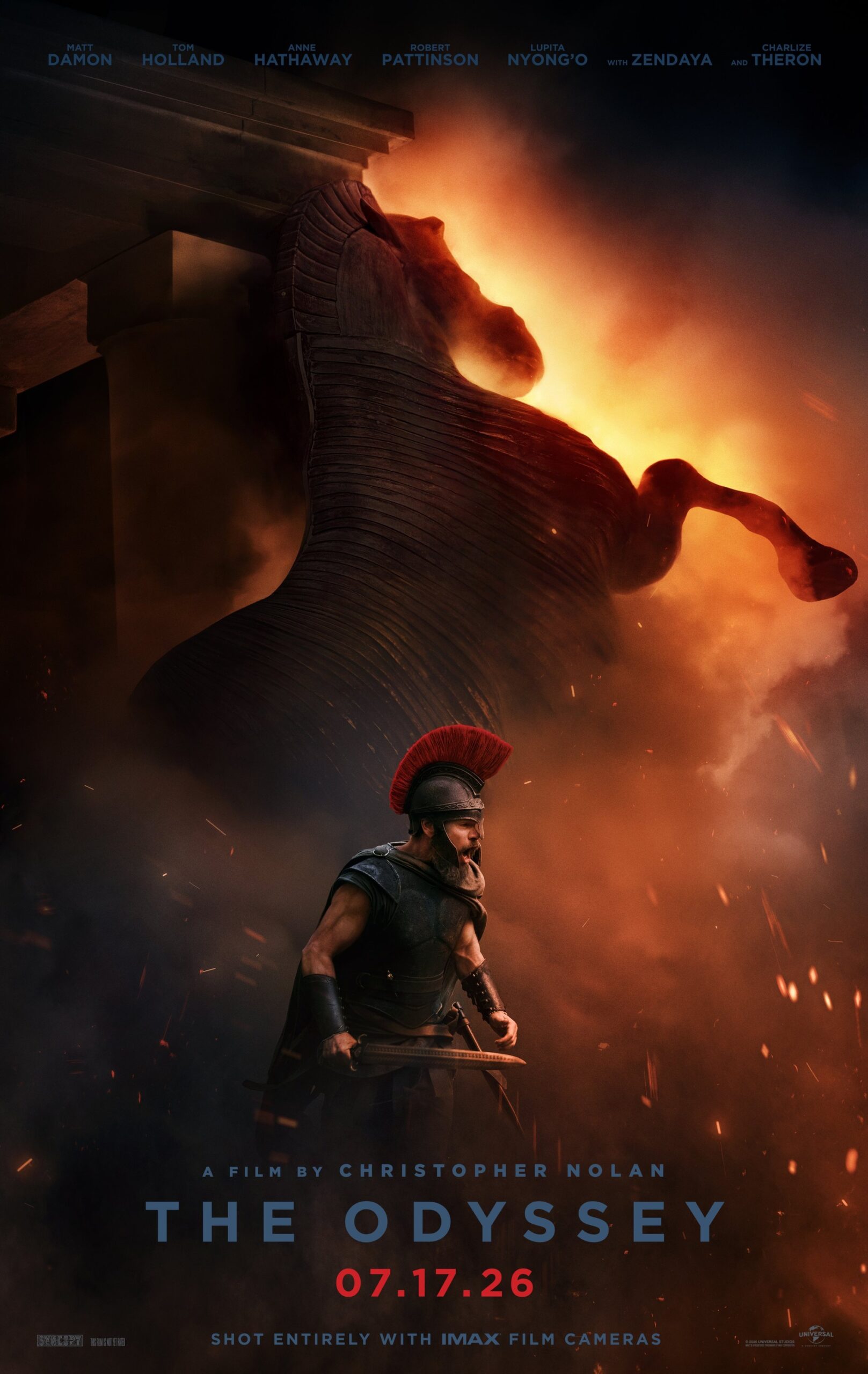

When Christopher Nolan announced he’d be filming Homer’s epic, The Odyssey, many assumed he’d take the “grounded,” “realistic” approach on display in his Batman trilogy. This assumption isn’t wrong, but it is misleading. Nolan’s latest film isn’t grounded in Homer’s narrative worldview, nor in any attempted historical reconstruction of the decades-long conflicts in late Bronze Age Greece and Anatolia that the epic poem immortalizes. Rather, Nolan’s The Odyssey is an almost total repurposing of its source material, a consciously modern and deliberately American meditation on the loss of social piety, the hardening of hearts, and the decline of civilization. If you can appreciate this idiosyncratic approach for what it is, then you may enjoy The Odyssey more than this reviewer was able to do.
Caveat Emptor
A film this vast and this peculiar is hard to adequately review, and, due to Nolan’s angle and some of his choices, this movie is likely to be somewhat divisive. In the interests of objectivity, then, let me first note that this was not the kind of adaptation I was hoping for, which naturally influenced my own enjoyment of the film. Setting my expectations aside, then, and taking the film on its own terms, I still found some things to love about it, along with elements that were poorly thought-out or which, for me, simply didn’t work. For brevity’s sake, this review will restrict itself to broad strokes.
The Good
Nolan’s The Odyssey has powerful themes, even if they are not always identical to Homer’s themes. Nolan’s narrative explores the connections between household piety and hospitality (“the Law of Zeus”) and the eventual course of civilization. While the gods themselves appear only obliquely here, the laws they embody and the effects of setting them aside still pulse in the background. We do witness some real magic and one personified god, but these are presented as occult forces, dimly perceivable and mysterious. There are crimes against gods and crimes against humanity, both of which have their macroscopic and social consequences, and these, like the natural wonders Athena mentions to Odysseus, may serve as fingerprints of the gods. But there is a certain philosophical naturalism to this story world. Nolan’s Circe (Samantha Morton) is no wicked temptress but a plain-looking witch, ill-used and vengeful toward men and their appetites. Calypso (Charlize Theron) looks the part, but her efforts are presented as more therapeutic than seductive. Athena (Zendaya) has a face and a voice, but flashbacks later in the film suggest even these are partly illusory, an anthropomorphization of Odysseus’ stricken conscience over his fateful sin against the common gods.
And what was this sin?
Not hubris here—his defiance of the gods is presented as admirable if ultimately futile—but treachery. Specifically, by conniving to conquer the Trojans by means of a gift, Odysseus (Matt Damon) and the Greeks betrayed the Law of Zeus, the same law of hospitality and social piety by which a beggar or stranger is received into one’s home—because he might be a god in disguise. The Greeks used the Trojans’ hospitality against them.
This betrayal meant victory in the short term, but, as Odysseus explains to Penelope, it guaranteed the progressive rot and decline of Mycenaean Greeks and their civilization of Bronze. Because of Odysseus’ crimes and those of Agamemnon, whose face behind the mask Nolan wisely never shows, the mysterious Sea Peoples will come to burn the world. The Law of Zeus, that is, the Law of Hospitality and Family, forms the root of social order, and its various betrayals here spell the doom of all. While Odysseus and Penelope’s loyal love and personal virtues might have won them the chance to sail off into the sunset, a course Penelope (Anne Hathaway) originally suggested to avoid a war they both deemed dubious, their world will not escape so easily.
In Nolan’s telling, all of this could have been avoided if war had been avoided, a war that had more to do with controlling trade routes than recovering Helen. Like so many wars, Nolan seems to say, this one was built on propaganda. When we finally see Helen (Lupita Nyong’o), one side of her face is deeply disfigured, though Nolan doesn’t explain the wound and we’re left to wonder whether it’s meant reinforce the idea that the war was never about her or to suggest that Menelaus, a brute of a man, punished her for eloping. Either interpretation serves Nolan’s focus on the social costs of war, including and especially to civic mores, to basic honesty, and to women. As the above makes clear, Nolan’s take on Homer is thematically layered, but modern in its approach. Naturally, it also displays some breathtaking technical elements.
Despite the dark, washed-out look of the trailers, the color palette in the actual film is quite varied and vibrant. The movie is dark when it needs to be dark, but there’s plenty of lush color on the various Greek islands, and I enjoyed the stark contrasts of dark and light, which seemed to serve the themes. Eschewing most CGI, Nolan used real boats, real extras, and a lot of practical sets. The cyclops scenes used a sixty-foot practical model, and you definitely feel that physical presence. The scene where Circe turns Odysseus’ men into pigs was wonderfully thought-out, downright creepy, and seems to have been achieved through makeup and camera tricks.
The ships, weapons, and armor were not always period-accurate, though this artistic license seems to fit with the film’s conscious disregard of any particular moment in history, a point to which I’ll shortly return. In any event, the flashbacks to the Iliad and Trojan War were very engaging. Nolan shows us the Trojan Horse from the inside, and the scene was so tense and claustrophobic that I found myself gasping for air and smelling the stink of the men. Nolan makes us believe that this daring trick might actually have worked, and the way he films it, with dark-helmed Greeks silently slaughtering white-helmed and unsuspecting Trojans to the pounding of drums and the blaring of horns transforms this deed of daring into a sort of black magic. I do not think it would be an exaggeration to say that the Trojan Horse is this film’s atom bomb, and Odysseus is its Oppenheimer.
The Bad
Even making a generous allowance for the differences in intent behind Homer’s Odyssey and Nolan’s, there are some things I can’t let pass. The dialogue and the writing in general left me frustrated, sometimes astounded. Characters often speak and even think as if they were contemporary Americans. There’s a glibness and crudeness both to the written dialog and to the manner in which it’s delivered. I cringed every time a character said a word like “daddy” or when an aristocrat in a dispersed, pre-Athens fiefdom used an anachronistic, metacognitive expression like “our civilization.” Then there is Odysseus’ disproportionate and ahistoric sense of war guilt, as if conquest and plunder were not the accepted outcome of an extended siege, and Penelope’s hilariously modern complaint to Telemachus that she should get to sit on Odysseus’ throne!
Tom Holland plays Telemachus with all the epic awareness of a television actor, and Jon Bernthal’s Menelaus seems to have wandered onto the set from a truck stop somewhere just off-camera. Robert Pattinson, whose performance Nolan praised as on the level with Heath Ledger’s Joker, plays the would-be suitor Antinous as one named goon among many, lacking only a mustache to twirl in order to complete his performance.
Finally, there is the matter of Elliot Page. Known as Ellen Page when she starred in Inception, Juno, and the X-Men films, “Elliot” assumes the male role of Sinon, a character imported from the Aeneid, whose slight frame, boyish looks, and circumstances of conscription are meant to highlight the social injustices of war, as well as Odysseus’ guilty conscience over the deception of the Horse. The problem, for the film, is that she’s just not believable in this role, yet one feels that Nolan is counting on his audience to keep mum and nod their heads. Sadly, this performance is just one more anachronism that obliterates a viewer’s immersion.
The Mid
Like Memento, The Prestige, Insomnia, and many other Nolan films, The Odyssey plays with our sense of time and perception. Odysseus’ story starts on Calypso’s island, and it overlaps with Penelope and Telemachus’ experiences on Ithaca. Odysseus, with help from a therapeutic Calypso, recalls his story in flashbacks, not all of them in order. While this narrative approach makes perfect sense, it was not as effective here as in other Nolan films. The film’s pacing is weird. For example, the voyage home, which is supposed to be a long affair, feels relatively short, while, paradoxically, it displays a certain repetition that sometimes makes the film drag. The same weird pacing characterizes the Homecoming sequence and, especially, the fight with the suitors. In a bizarre, repetitive sequence, Odysseus single-handedly kills about a hundred people while one of his evil servants periodically drops weapons down to the bad guys through a hole in the ceiling as weak Telemachus repeatedly tries and fails to stop the weapons-dropping operation. The scene is supposed to feel tense and climactic, but the exact same cycle repeats three or four times as the scene crawls towards its foreknown conclusion. I would have preferred the fight be shorter with more of a sense of progressive complication, and more attention be given to Odysseus’ reunion with the faithful dog Argos, or with his own wife.
Matt Damon as Odysseus certainly looks and often feels the part, but there are a number of strange writing choices that undermined Nolan’s characterization of him. For example, Nolan chose not to include the famous “Nobody” exchange with Polyphemus and instead has Odysseus shoot the already-blinded creature in the eye with an arrow just as his surviving men are on the point of escaping cleanly. Why? How does this idiotic and reckless choice jibe with Odysseus’ stated love for his men, or with his professed desire to get them home? The same questions arise when Odysseus and his men encounter the Laestrygonian child in full armor, and neither “wily” Odysseus nor any of his men have the good sense to turn around immediately. The inevitable slaughter that follows is supposed to be terrifying, but it felt almost slapstick and, again, was easily avoided with a little foresight. Perhaps we viewers are meant to draw the conclusion that Odysseus, whom we later learn is ambivalent about returning home, is also ambivalent about saving his men? But this possibility clashes with Odysseus’ characterization in the Circe, Hades, Sirens, and Strait of Messina scenes. The most generous conclusion one can make is that Nolan wants us to see his Odysseus as a “complicated man” (as per Emily Wilson’s translation), but if so, the “complications” seem actually to be located in a script that doesn’t know what it wants to say.
A Pyrrhic Achievement
As previously mentioned, it’s a mistake to approach Nolan’s The Odyssey as either an attempt to bring Homer’s work to life on its own terms, or as a period-piece, grounded and realistic, based on some reconstruction of the historical conflicts between Mycenaean Greeks and the historical Troy. The Odyssey is better viewed as a deliberately timeless fantasy film, one that combines elements of the Iliad and the Odyssey and bits of real history (the Sea Peoples), with ethical and philosophical considerations about the connection between the decline of personal honor and piety and the decline of civilization in our time. Viewed in this way, the film offers an interesting meditation that, like the film’s odd pacing, is probably meant to feel both atemporal and ever-current, and it therefore seems to me that criticisms about the film’s unrealistic racial casting choices and lack of Greek actors slide off of it, no more relevant than they would be in a modern staging of some Shakespeare play with a deliberately contemporary twist. On the other hand, the dialog, plotting, pacing, narrative choices, and much of the acting, left me shaking my head—and sometimes checking my watch.
Though this jaded reviewer did not much enjoy Nolan’s take on The Odyssey, the film carries enough interest on technical and thematic grounds that many viewers might reasonably consider it “good.” Yet critics have over-praised the film. It is far from Nolan’s greatest, possibly his second or third-worst, and to call it a masterpiece is an intellectual fib of epic proportions.
Content Note for Parents: The film has several short scenes of sexuality without nudity. The Sirens, though seen only from a distance, are fully nude. Characters frequently used harsh language, including modern four-letter words. Violence is pervasive but not overly graphic.