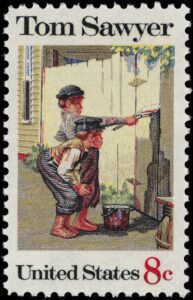

Mark Twain’s beloved character, Tom Sawyer, is a well-established American icon—and rightly so. Many are drawn to The Adventures of Tom Sawyer (1876) because Tom typifies the All-American barefoot boy growing up in the 1840s in the idyllic town of St. Petersburg, a Mississippi River hamlet in America’s heartland. Generations of readers have loved Tom for various traits: his grit, guile, mischief making, type-A personality, his Romantic skylarking, or any combination thereof. But beneath his charm and hijinks, much of Tom’s character development can go under-appreciated.
Similarly, Mark Twain is better remembered as a humorist than as a moralist, as evidenced by the annual Prize for American Humor dedicated in his name. But in his preface to Tom Sawyer, Twain invited more mature readers not to dismiss his work as a mere boy’s adventure novel: “Although my book is intended mainly for the entertainment of boys and girls, I hope it will not be shunned by men and women on that account.” With this in mind, readers may notice that as the laughter subsides, Twain’s storytelling moves with the folksy skill of “fellow feeling,” the mirroring of the sincere emotions of another person. Twain teaches it to Tom while using it with the readers—especially disarming his middle-grade readers—to shape their affections and empathy. That so-called soft skill of “fellow feeling” that we learn from the book is actually crucial for virtues like courage and justice, which are necessary for the conscience of a young boy and a well-ordered society.
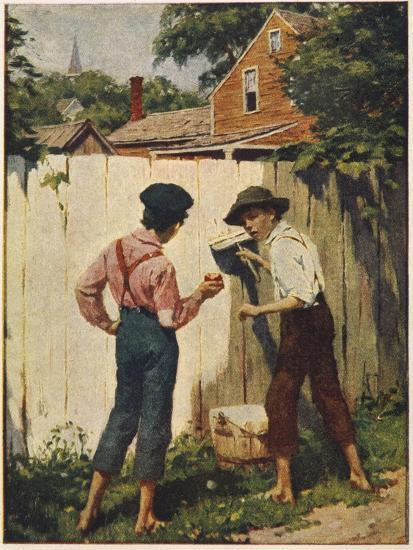
Twain primes the character of Tom for freedom, adventure, and risk-taking behavior by removing his parents from the picture: his mother is deceased and his father assumed so. The kindly widow, Aunt Polly, takes on the tall task of raising Tom, whom she describes as being “full of the Old Scratch,” especially when juxtaposed with his half-brother Sid, a “goody good” who tattles on Tom every chance he can. Tom and Sid characterize “The Story of the Bad Little Boy Who Didn’t Come to Grief” (1865) and “The Story of the Good Little Boy Who Did Not Prosper” (1870), respectively, and writ large. These were two of Twain’s early narrative sketches—satirical inversions of the simplistic, saccharine moralism found in McGuffey’s Eclectic Readers, a popular schoolbook series at the time. In short, Tom Sawyer is a story of second chances and redemption, especially after Tom undergoes a much-needed comeuppance.
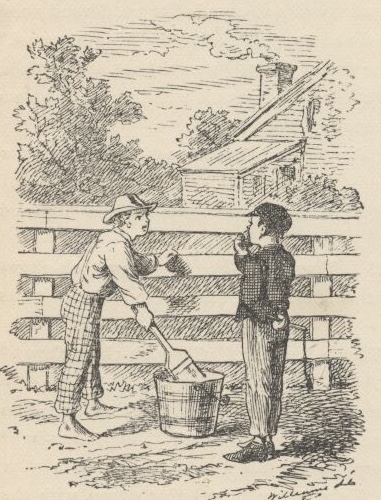
The famous whitewashing scene features early: Tom psychologically hoodwinks the neighborhood boys into thinking whitewashing the fence is not work but rather play—a fun activity. They then do his work for him, even paying him for the privilege of doing his chore. This is such an amusing display of Tom’s guile over his peers’ gullibility that the reader is easily carried away by the success of Tom’s artifice. But here, Twain’s use of the term “whitewash” is telling—and similar to his later use of the term “carpetbag” in Huckleberry Finn (1884). It conveys, through imagery, a concept of deceit. To “whitewash” means to intentionally hide some kind of wrongdoing, error, or unpleasant situation—or deal with it in a way that attempts to make it seem less bad than it is. This strong verb harkens back to the deceit of the Pharisees, whom Jesus called out as “whitewashed tombs” on the outside, while harboring corruption and treachery within (Matthew 23:27). Reflecting Twain’s own day and age, this scene can be understood as an adolescent reimagining of The Gilded Age (1873), Twain’s satirical novel about corruption and greed after the Civil War. Of special note is the first payment that Tom gets in exchange for a unit of work: an apple from Ben Rodgers. In case we miss the reference to the Fall of Man, the next chapter will replay the image as Tom gets an apple and a scriptural flourish from Aunt Polly for a fence well whitewashed, before hooking a doughnut to boot. By the time the fence is coated three times with whitewash, Tom is “literally rolling in wealth,” having bamboozled the neighborhood boys out of “a kite, in good repair… a dead rat on a string to swing it with… twelve marbles, part of a jewsharp, a piece of blue bottle-glass to look through, a spool cannon, a key that wouldn’t unlock anything, a fragment of chalk, a glass stopper of a decanter, a tin soldier, a couple of tadpoles, six fire-crackers, a kitten with only one eye, a brass door-knob, a dog collar—but no dog—the handle of a knife, four pieces of orange peel, and a dilapidated old window sash.” Tom would have “bankrupted every boy in the village” had the whitewash held out, but sure as pride comes before the fall, this triumph was a necessary setup for our hero’s moral growth.
Twain’s humor at first outshines his moralism; in effect, he is able to “bury the lede” so as to win over readers. We laugh out loud at Twain’s signature comic flair, only to be ultimately won over by the moral arc of Tom Sawyer’s character development. Preferring to be both funny and critical at the same time, Mark Twain skillfully shows how comedy is an endearing prelude to a more enduring critical lesson. In Tom Sawyer, Twain ingeniously links the whitewashing episode to a later Sunday School debacle, both not only memorable for their hilarity, but also—and more importantly—because they convey a serious moral import for the novel.
While surrounded by his peers, their families, Judge Thatcher, Becky, and “the quality” of St. Petersburg, Tom presents himself to the Sunday School superintendent for a prize: a new Bible. To earn the prize, pupils had to commit two thousand scripture verses to memory, all the while earning yellow, red, and blue tickets, which could be redeemed for the Bible. Tom Sawyer did not actually earn scripture tickets, but rather had obtained tickets by trading away many items he gained from his whitewashing trick! “The boys were all eaten up with envy,” Twain writes, “but those that suffered the bitterest pangs were those who perceived too late that they themselves had contributed to this hated splendor by trading tickets to Tom for the wealth he had amassed in selling whitewashing privileges. These despised themselves, as being the dupes of a wily fraud, a guileful snake in the grass.” When Tom presents himself to demand a Bible from the Sunday School superintendent, everyone else present will have the last laugh. Proud to do the honors as the new judge in town, Judge Thatcher, thinking Tom will shine before the gathering, publicly asks him the names of the first two disciples, to which Tom answers, “David and Goliath!” When the howls of laughter subside, Twain’s veiled moral is clear: Tom’s cheap scrip cannot be cashed in for true Testament, just as one can’t lie, cheat, or steal their way into heaven.
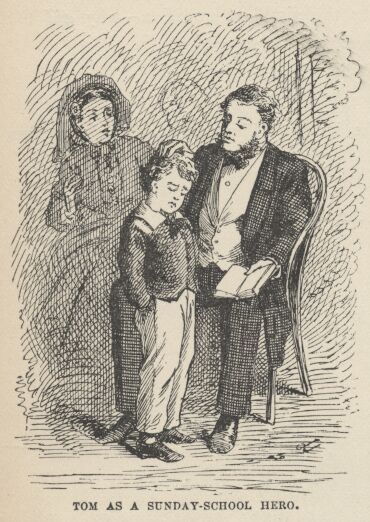
With subtle skill, Twain pairs the whitewashing and Sunday School scenes to remind his readers of the moral shortsightedness of not only the Gilded Age but also the Protestant Work Ethic, a Calvinist belief that work and earthly wealth are an indication of being saved in the next life. Apparent success is not enough. Tom must come down from his high horse, learn a lesson in humility, and earn his glory the old-fashioned way. With whitewashing, Tom fell for the fallacy that we all do when we selfishly choose a lesser, more immediate good. Tom rides the wave of budding psychological machismo, until his very public correction, which hastens Tom’s maturity and moral development.
Tom’s next instance of significant moral growth is brought on by a streak of selfishness and self-pity. Heart scalded by apparent mistreatment from Aunt Polly and Becky Thatcher, Tom decides to run away to Jackson’s Island and play pirates as “The Black Avenger of the Spanish Main,” bringing along his friends Joe Harper, “The Terror of the Seas,” and Huck Finn, “The Red-Handed,” in an idyllic yet narcissistic escape from reality. Living off the land in their imaginative play on the island for days on end, these three boys are clueless as to the great grief they cause for their families and the whole of St. Petersburg, who search the river for the supposed-drowned boys. Later, Tom sneaks ashore to St. Petersburg, where he overhears the prayers and grief of Aunt Polly, Sid, Mary, and Joe Harper’s mother. Tom shudders at how his selfishness has caused others to mourn unnecessarily. Thus begins a series of major movements of the heart in which Tom feels deep sympathy for the plight of another and acts to relieve their burdens. Tom has been gifted with seeing himself through others’ eyes, thereby learning to see his life as wonderful and of inestimable value. Little wonder Frank Capra’s It’s a Wonderful Life depicts George Bailey’s guardian angel, Clarence, leaving a copy of Tom Sawyer after getting his wings, as his job was to get George to reclaim himself from self-pity and the brink of suicide.
While the next chapter’s depiction of the three boys crashing Tom and Joe’s funeral is humorous and entertaining, it must have been a sobering lesson for Tom, and undoubtedly served as an examination of conscience. As they walk down the aisle of the church to a heartwarming scene of rejoicing, Tom “got more cuffs and kisses that day than he had earned before in a year.” Yet we see a calibration of Tom’s moral compass as he notices the slinking Huck Finn and exclaims with fellow feeling, “Aunt Polly, it ain’t fair. Somebody’s got to be glad to see Huck.”
More deep sympathy will be seen when Tom takes a thrashing for Becky and when he smuggles “small comforts” through the jail window to the falsely imprisoned Muff Potter. No matter that Tom failed to remember the Sermon on the Mount for Sunday School; now his heart is beating with the Beatitudes. He’s developing that “fellow feeling.”
Tom goes all-in for following his conscience when he testifies in court against Injun Joe, telling the truth of what happened in the graveyard that fateful night. This is a magnanimous act on Tom’s part, revealing greatness of soul. Tom answers his conscience and puts another foremost at his own peril, proof positive that all that’s needed for evil to prevail in the world is for good men to do nothing. It is hard to find greater devotion to one’s fellow man than the courageous loss of personal security. Indeed, at the climax of the book, Injun Joe reappears to exact vengeance. Using a nearby cave as his hideout, Injun Joe figures a minotaur for the trapped and lost Tom and Becky. Here Tom is elevated to the mythic level of an American Theseus: in his resourcefulness, he trails a kite-line to save them both. But the virtue of fellow feeling has overtaken him: When Judge Thatcher has the cave entrance sealed and triple locked, Tom feels such deep sympathy for his nemesis: “Oh, Judge, Injun Joe’s in the cave!” Sharing deep sympathy for Injun Joe trapped and starving to death in the cave, Tom knows too well the proverb: “But for the grace of God, there go I.” Having such strong feelings for one’s mortal enemy is telling of Tom’s character development indeed.
The last chapter shows Tom revisiting his classic hijinks, but now for a greater good and the undoubted betterment of another: Tom convinces Huck that he will only let him join his gang of “robbers” if Huck will accept the invitation to live with and be raised by the Widow Douglass. Huck wants to go back to living alone by the tanyard, sleeping in his sugar hogshead barrel as a low down, carefree vagabond. But out of sincere fellow feeling and compassion for Huck’s best interest, Tom will not allow Huck to drift away and live on the margins of society. Yet rather than stamping out his signature wiliness, Tom will start using it for the benefit of others.
One last unifying detail of Twain’s veiled moralism can be seen in how these two boys are rewarded for their good deeds and moral growth. Injun Joe hides his treasure in the cave “under a cross” marking “done with candle smoke.” Twain’s moral can be found after some digging. Tom and Huck find $12,000 in gold not where “X marks the spot,” but under the sign of the cross. It hints that Mark Twain believed, perhaps in a veiled sense, that the real “gold” is ultimately to be discovered under the Sign of the Cross. Perhaps Twain buried the lede because we are typically more like bad little boys than good, and because all bad little boys need second chances not only to avoid grief but to help others in need. We admire Tom Sawyer for the hard skill of his courage, his most identifiable quality. Standing fast for good in the face of danger is indeed the noble virtue of which heroes have always been made. However, the often-hidden power of Tom’s fellow feeling and kindness serve as a catalyst to transform that courage into a service for others. Because of what the cross signifies, Twain shows that a healthy society is reliant upon fellow feeling, the common good, justice, and if need be, laying down one’s life for a friend. For boys of the middle school years (and above), The Adventures of Tom Sawyer illustrates that fellow feeling is the pathway to virtue, which defends truth and goodness when deceit and selfishness present themselves in their whitewashed facade.