

It was the perfect day to be on the river, though that’s not specific enough—every day is the perfect day to be on a river. The word “river” is filled with the mystery of what-can-be, adventures unfulfilled, and the unknowns that wait around the bend. But this was one of those mid-spring days that carried the harbingers of summer and no school, when you can smell freshness and the barn; with a cheery-blue sky and white puffy scattered clouds, warm but not too warm, the trees that vibrant vernal-green that serves as an iris-salve, still recovering from months of grey and brown. The dogwoods had blossomed, and the sycamores were coming into their own, towering above the riverbanks as we paddled our open-top whitewater kayaks (“sit-on-tops”) out of Seneca Creek into the great waterwaylake of the Potomac above the Seneca Breaks.
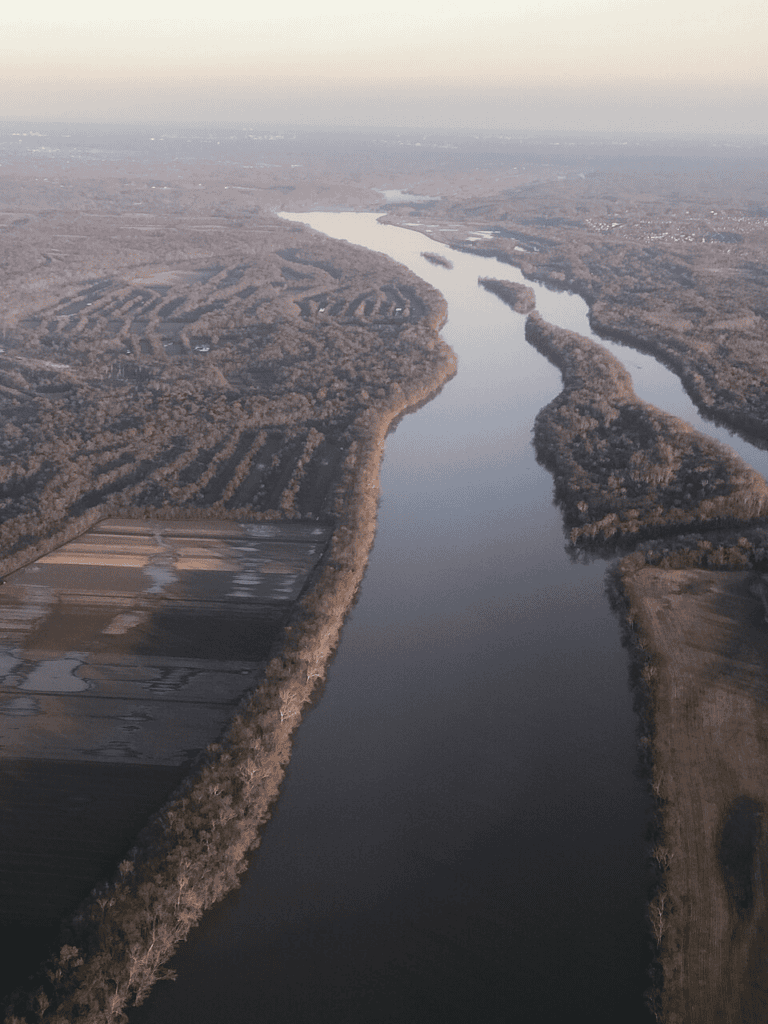

Running sweep for a group of eighteen boys that afternoon gave me the gift of “toodling” as the nine-and ten-year-olds fanned out across the water, zig-zagging and bumping into each other. As I spun in circles, keeping an eye on the flock while taking in God’s grandeur, a cacophonous honking commenced on my left.
“Mr. Naegele! HEELP! MIS-TER NAE-GE-LE! My parents are LAWYERS—I’ll sue you! HELP!! Mr. Naegele!”
This was not from a goose but from a boy, and for a moment I remembered walking the dog on the bank of another river at another time. I’d watched the reunification of a lost goose with its skyward skein upon a sandbar littered with little piles of spent snow one cold late afternoon at the end of Mountainwest-October. Now I paddled over to the desperate boy.
“Mr. Naegele! I’m dying! I’m drowning! I’m sinking! Bring me to land! NOW!” He was wearing a PFD (personal flotation device) while sitting in a boat upon flat water no deeper than four feet. And land was within three strong strokes. His cries for help had paused the whole crew, and now a flotilla of sit-on-tops twirled in circles attempting to float still. I told him he was doing none of the above. He ordered me to bring him to land again. I said I would do no such thing and that he should pick up his paddle. He was no longer hyperventilating. I started to paddle away, and he paddled after me, screaming that he would bring the law upon me. His parents would be calling the police. He’d have me fired.
My friend and co-lead paddled up. We conferred. The hired hands came paddling back. We can bring him to land. Nope. We can put him in a tandem. Nope. What about a canoe? Nope, he’s staying in his boat. He’ll wake the dead. He’ll stop. There’s no way he can do it. He will. We paddled on. About fifteen minutes later, running a little Class II in the GW canal, the boy blitzed past Mr. Mehigan with a nervous smile upon his lips—“Mr. Mehigan! This is the funnest day of my life!”
Boys don’t always know what is best for them. Without proper training, we tend to make decisions that will protect us: rather than choosing the path less traveled, we choose the path of least resistance. What is safe is considered sound. What is a challenge is considered unnecessary.
One day, while discussing the classic tale of “Jack and the Beanstalk” with my sophomore philosophy class, I asked if the boys were to wake one morning and find a giant beanstalk soaring into the sky in the backyard, who would climb it? A few suggested they might, but most said no. One boy said he’d just chop it down. But what if your family was destitute and you had no job prospects? He said he’d still chop it down. Too much risk. Who knows what’s at the top? Or if there even is a top. Plus, he added, giants aren’t real.
It was another year, on another river, this one in West Virginia, on an overnight trip running the Cheat River Narrows. We had left the full-green of the Tidewater, driven over the un-leafed mountain pass in western Maryland and down into the Mountain State, where the sycamores were still in bud. It was a chilly day, the biggest water the boys had seen, some beefy holes and roiling waves. We pulled the boats over in the late afternoon sun to jump off a massive boulder perched above a giant eddy. Our guide for the day, an Australian nicknamed “Aussie,” suggested anyone could opt out. All but three boys sat in their boats waiting to move on. A glance between Mr. Mehigan and me demonstrated that we were in agreement. Everyone out of their boats! All of the boys jumped. “It’s warmer in the water!” one of them called amidst squeals of joy.
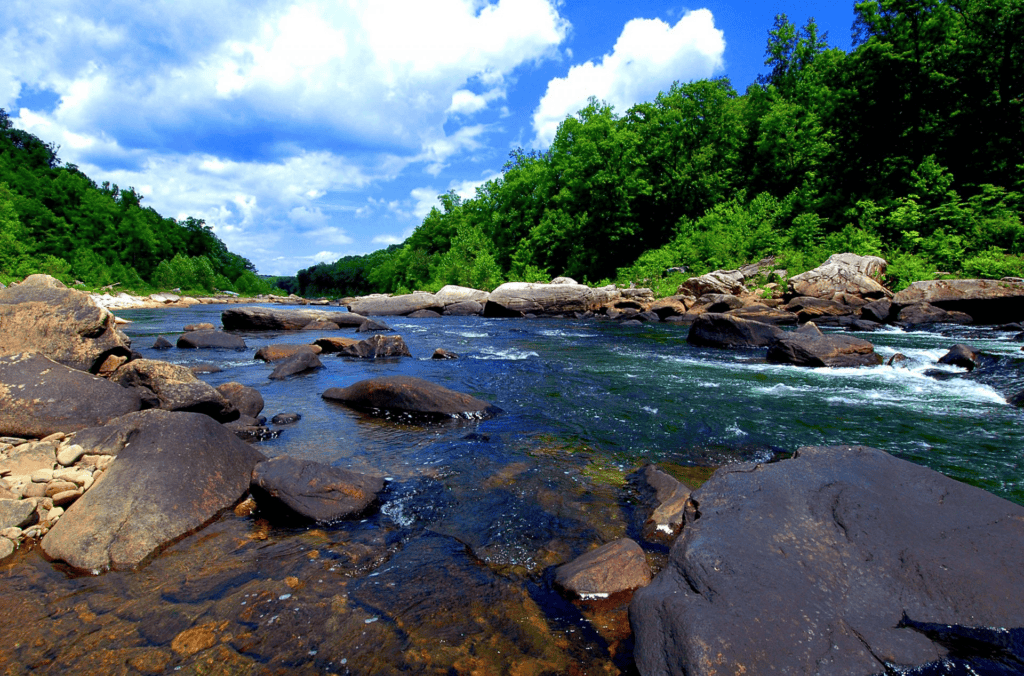
Down the river, we stopped in an eddy river-right to scout “Calamity Rock,” a chunky boulder which sat midstream at a pinch point in the river, a Class III+. Aussie asked who wanted to swim the rapid before running it in our boats. This time we all looked at him like he was crazy. Have you swum it before? I asked. He hadn’t. But why not? He jumped first. Several of us followed, all of us jumping more than once. The key was to hit the water where the glassy tongue gave way to a standing wave. If you hit the seam just right, you could go deep underwater and then ride the rollercoaster current, maybe bouncing off the elastic eddy-line below the rapid before popping up like a cork and swimming to the boulder-strewn shore. What can be swum can certainly be kayaked. This time we allowed the boys to choose, and more than a handful jumped. They had jumped off of a fifteen-foot boulder; what was the danger of a three-foot leap?
On the shuttle drive to pick up the third vehicle, Aussie and I were ecstatic about the day, but talk soon gave way to challenges and risk-taking. In the outdoor industry, similar to categorizing types of “Fun” into three parts, so we can divide up risk-taking. At the center is the “comfort zone,” a safe position of enjoyment where we feel firmly in control. Think of sitting on a beach reading the latest Garden & Gun with the occasional glance at the pelicans patrolling the sea. One step out is the “challenge zone,” where we may cede control to the unknown and are pushing ourselves beyond what we deem our capabilities. The heart rate quickens, hesitation enters our gait, our mind is caught between “do I or don’t I?”Back at the Cheat River beach, we enter the water, even though the waves are a little taller and you can’t always touch the bottom. Swimming across an amber-toned glacial lake to a massive boulder a half-mile from shore, you stop swimming to bob in the water after five minutes, and there’s still a long way to go, both forward and in reverse. But you’re wearing a PFD, and if you’re tired, you can take a breath and block out the thoughts of the monsters lurking in the darkness below. The third zone is the “danger zone.” This is where consequences become far more real. “Actions have consequences” is no mere saying; the absence of truth is a grave error. Decisions are no longer ripples on a pond, but life or death, flow of grace or broken spigot. It is the “danger zone” for which we prepare.
**
The borders of the zones are flexible. The “challenge zone” for a ten-year-old is more than likely within the realm of the “comfort zone” for an adult. The challenge for the trip leader is to broaden the boundaries of each boy’s respective zone and aid his decision-making capabilities. The goal isn’t safety—if this was the case, we wouldn’t put them in boats in the first place—but rather, learning to adventure prudently. Sometimes this means eliminating the freedom of choice and making decisions for them ourselves because, as parents and educators, we know better. The boy wants to go to public school and we want him at The Heights. This is not to say that we eliminate a boy’s ability to make decisions on his own, but sometimes because they lack prudence on their own. We lend some of our will and wisdom so as to inform their own decisions later. The consequences of the Cheat River cliff-jump versus the Calamity Rock swim: the first decision made by the teachers allowed for the boys to more confidently make a decision about a rapid-swim.
It is in the “challenge zone” where most growth occurs. We learn our limitations and lack thereof. That was not so bad—it was actually fun—or, that was cool, but not really my thing. Maybe it can be tried again in a year or so. Mark Twain noted that “courage is resistance to fear, mastery of fear—, not the absence of fear.” Courage is learned and taught; it is built triumph by triumph. A shepherd brings his flock to a new field and lets the sheep roam. He is not offering limitless choice but showing them where to eat. He’s not telling them what to eat, though—through trial and error, those sheep find what is good to eat, and it is passed down from ewe to lamb through tradition.
We cannot assume that our boys will always make the right decision, but we can decide when we should or should not make decisions for them. When they seek the “comfort zone” too often, we nudge them back into the “challenge zone.” Send that boulder, but not that cliff. And as they become more informed, we ask: What is the gravity of this decision? Think it through. Run that rapid river-left, but pull over and scout it first. Later, when they spread their wings and leave the nest and, after some dalliances with the “danger zone,” inevitably face some defeats, we let them know that we will find them, even when they are left behind, calling for help on a snow-streaked sandbar in the middle of an unknown river at the dusk of day; that we’ll circle back, and amidst a clamor of joy, welcome them back under the shadow of our wings.