

Late October 2026
The hickories at The Heights are approaching their fever pitch by the deck where I sit, below the library on the west side of our campus. Standing around the upper bowl of the “Valley,” their leaves turn a deep, brilliant yellow, the first significant sign of annual decay besides an ornamental maple by the southwest corner of the “Old Log Cabin.” Meteorologists would have us know that the trees are “late” to change this year, but the leaves lose their green precisely when they mean to, dependent on the sun, the rain, and the cold air that adds a little excitement on woodsmoke-evenings and another layer in the darkening mornings. When those three work in concert, the sugar maple by the lower school amphitheatre is a fiery-orange backdrop to the rhythmic chant of the Weïrd Sisters from Shakespeare’s Macbeth or Lewis Carroll’s lolloping “Jabberwocky” during the lower school All Saints Day bard competition. October is one of those times that our campus really comes to life—the weather is such a treat—the air musty but sweet—when it may just be a crime to be inside.
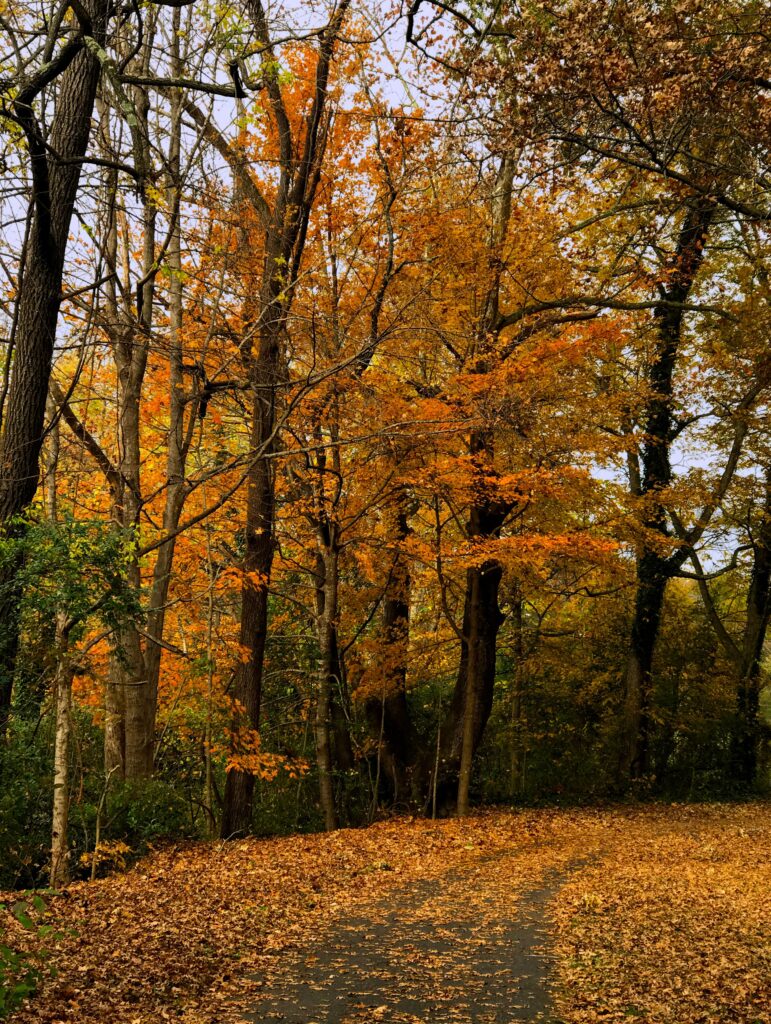
The sound of boys emptying out of the Valley classrooms below carries the ring of a long-distance call, and after vacillating, I answer the inner coffers of the memory: A boy gathering acorns for the next day’s raid of a fort, grocery bags full of a squirrel’s late winter meal… Football games around a tall triumvirate of tulip poplars that a boy may not be privy to if he had not recited his times tables in fewer than twenty seconds… Midday, one Tuesday afternoon below the long-deceased white oaks by the gazebo wondering what it meant for a plane to fly into tall buildings in faraway New York City… Now, in “no-man’s land” in an all-school, all-campus game of Capture the Flag, a natural shag-carpet of pine needles underfoot behind the soccer field… Now waiting in the branches of a sugar maple below the old main building before retreating to its base and opening a book as the last of the boy’s friends is picked up, trusting that soon enough he too will climb into a car for the long drive across the river… Running, tackling, talking, praying, occasionally studying, on a campus that was so much more than a utilitarian collection of buildings. Not a campus, no, a home. A home on land so well known that fifteen, twenty, twenty-five years later, memories merge; smells with colors, sounds with sight, then becoming now; synesthesia amidst the synthesis of time and place, serving as a rooted tree that has long out-lasted the many hewn-trees that mark a boy’s memory.
The line is cut by the tolling of the Valley bell. Send not to know for whom the bell tolls; it tolls for thee.
In a suburban world of boring buildings and busy highways, we have lost our understanding and appreciation of the land. Perhaps not the land faraway where some of us have second or third houses, or in the national parks we visit for the pictures, but the land we live on, the little carved-out quarter- and third-acres where we rest our over-stimulated heads every evening. Charged to subdue the earth, we have opted to use it, dispensing with the art of caring for land in favor of the science of using the land to the square inch. And while the long-term answer is to re-populate the heartland and Appalachia, which the seasoned traveler knows is full of towns only alive in the imagination, as vast hordes of humanity have retreated back to the coasts and the big cities chasing jobs and dreams of “shaking the dust of this crummy little town off [our] feet” to make a living, the more attainable answer is simpler.
In a recent Substack essay titled “Your Culture is Dying Somewhere on a Riverbank,” Ryan B. Anderson notes that “culture” is derived from the Latin word, cultura, the root verb being colere, “to till the ground, to dwell in a place, to honor and revere.” This works in harmony with Josef Pieper’s consideration that leisure is the basis of culture, as leisure follows the value of work, which must be rooted, tied to something greater than self. When humanity last reached a zenith of decadence, the moment was met by monasticism, a call into the wild of noble souls who held the line in darkening times as what was once a great republic rotted from within. Rooted in place, abbeys and monasteries, which served as bastions of Christianity, cradles of civilization, and centers for education, gradually transformed culture, and from this rebirth of Western tradition, sprouted the modern world.
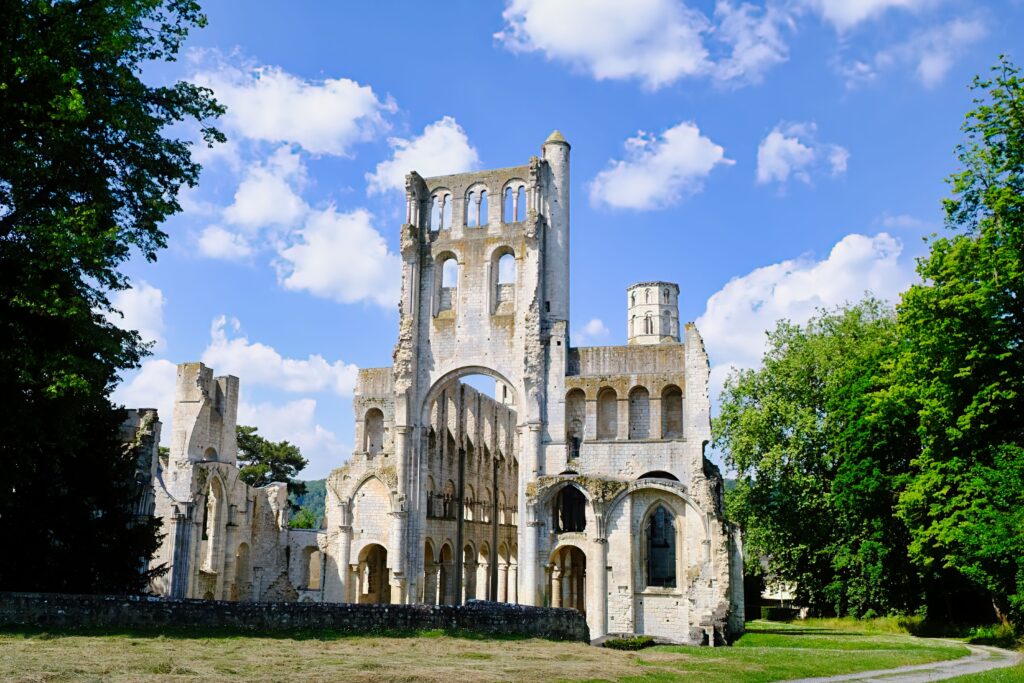
As we enter a second “Dark Age,” it will not be men in habits who come to save the day—the population shift and industro-technological revolution does not support such a hypothesis—rather, it will be ordinary men doing, to borrow from Chesterton, “extraordinary things.” It is not then a stretch to consider that the monasteries, those marvels of stone standing upon hills and nestled in vales that once transmitted Western culture, will give way to schools. Where laymen replace friars, schools replace abbeys. Schools rooted in place with campuses thoughtfully planned and preserved for generations of young persons and their families to dwell, to honor and revere—a place to know, a place to call home.
Of the basic principles, or “primary conditions,” of a school—willing parents, an able headmaster, a capable and comfortably-compensated faculty, students, an attentive but hands-off board with a shared vision, and a campus—the “facilities” are either considered the most important or the least, as some schools fail to even procure the land on which to build. In regards to the former, the pendulous response is not to consider the property as important, and regarding the latter, one need only look to the wildflowers for an answer. While it is the human-capital which needs the greatest investment, for proper human-flourishing, a great amount of capital must also be spent on developing a campus inspired by the land where it rests and designed for the people who will inhabit it: the students and parents, faculty and alumni for whom the campus will serve as a cultural center.
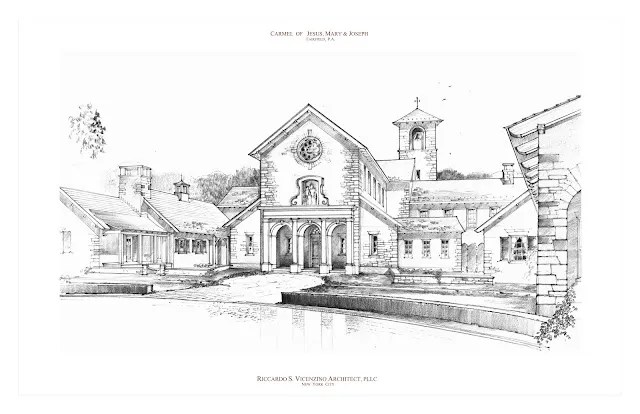
To accomplish this task, a campus must be planned with the end in mind. Too frequently, school buildings are built with a reactionary mindset and either fail to consider long-term needs or settle due to budgetary constraints rather than finding the donors (one need look no further than the vast sums spent on the midterm elections to see that there is money out there). Rather, a school needs to operate with a visionary mindset, the completed picture in mind, putting the plan and the vision in the hands of God, and plowing forward with abandon. Consider the Carmelite sisters in Fairfield, Pennsylvania: a sister’s $100-million dream of a stone monastery “built to last a thousand years” broke ground nearly a decade ago and is on pace to complete the project by 2040.
A campus plan should not be limited to that bane of modern schools, the monolithic building. These monstrosities that too often have the look and feel of a prison not only delay the dream for some, as they require a heftier up-front lump sum, but also limit its inhabitants from being rooted in anything besides an uncomfortable desk. One can too easily walk inside in the morning and never again feel the wind on his face until after the final class. (One might also find himself assigned to a fluorescent-lit, windowless office with a drop-ceiling on the third floor if he’s not careful!) A campus designed for “forced” outdoor time will improve the day of every inhabitant.
Beyond the land’s import (how to work with the undulations rather than flatten them, how to protect the trees, how to conserve the heavily-used land), a school must also consider the existing local culture it hopes to retain and transmit. For example, a school built on a former farm in New England, might consider how to preserve aspects of the working farm and utilize it in its curriculum. It might consider housing the lower school on the farm, the upper school in a “Village,” and the middle school somewhere in between. This would trace the historical route of a New England boy—one such comes to mind, who took a handful of classes in a local grammar school as a younger boy, decided that he hated school, learned the value of hard work on his father’s farm, and then requested he be allowed to resume his studies. You know that boy: his name was John Adams, the second president of the United States. The buildings on the property would echo this transformation, from clapboard buildings by the “Farm” to brick buildings by the “Village.” Fulfilling our birthright as men to name things grants both dominion and makes a campus more than a collection of “facilities.” A school campus is to be lived in, not to be used.
At the more granular level, attention should be paid to every detail—sturdy materials are a necessity at a school, but so is beauty. Mother Stella-Marie of Jesus, the Prioress of the aforementioned Carmelite Monastery, says about their project, “It’s not just the obvious places that should be beautiful—I want the janitor rooms to be beautiful…. Sometimes the beauty of the utilitarian spaces can be as important as the spaces where we pray….” As the sacramental of a beautiful chapel or church is necessary for divine worship, so is a classroom that is fitting for study, or an outdoor space for play. If boys are to be asked to write in class, that is, to approach contemplation in thought while putting pen to paper, it is not fair to ask them to sit in desks and rooms that are not fitted to such work. If children are to learn to take risks and push their limits, it is not fair to give them blacktop on which to play. If children are to grow up as readers and lifelong learners and develop friendships, they need books and a library; they need gathering spaces both indoor and out; they need quiet places to study independently and spots for group study; and they need storage space that fits their needs rather than a cramped hallway with double-stacked lockers.
A campus provides the space, the home, in which an education can take root, while recognizing that human dignity can be taught through space as it is taught through dress. As we would not wish for an ostentatious home, nor would we wish for gaudy buildings at our schools. This does not mean living in squalor, but seeking a beautiful and natural campus that elevates the tone and a refined, reserved sense of elegance and simplicity. As a house is cared for, so must a campus be, and as a family’s children help maintain a house, so too must students of a school, for they should feel ownership as they would their own home, a love of the land, developing a desire to return and walk amidst the trees of their youth long after they have moved away.