


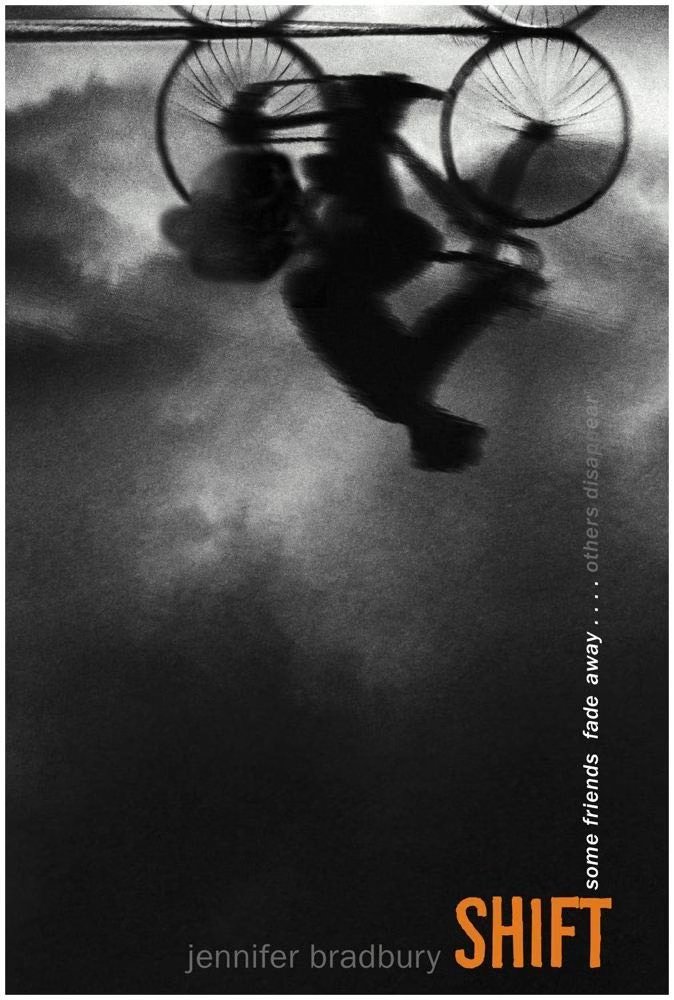
In Jennifer Bradbury’s YA novel Shift, friends Chris and Win (referred to by Chris as Chrisandwin) decide to bike cross-country to Seattle. No one thinks they can do it, but they find many people who longingly admire the idea, because everyone wants to have broken out of the path that was safest, easiest, or predetermined for them. Chris goes because he wants to prove he can do it, and his father encourages him. Win, a more tortured soul, wants to get away from his parents. The first-person narrative jumps back and forth between the erstwhile bike trip and Chris’ first year of college in the present day.
We know something is wrong when an FBI agent shows up at the college and starts grilling Chris on the topic of Win’s whereabouts. Win has disappeared, and Chris doesn’t know where he is, but no one really believes him. We learn that on the bike trip, Chris accidentally discovered that Win, who comes from money but pretends to have none, brought with him the staggering amount of $20,000. Chris respects his friend’s privacy—or is caught in the headlights—but is understandably concerned and hurt. Win’s secrecy is the beginning of a developing rift between the two, which culminates in an unprovoked, powerful, and genuinely antagonistic wrestling match in a thunderstorm, after which Win sabotages his friend’s bike and abandons him on the side of the road. The wrestling match is explicitly connected to a Biblical image introduced by an enthusiastically charismatic church group they meet on the road. The image seizes Chris’ imagination: the story of Jacob wrestling with the angel through the night. Both guys are the good guys, and yet there is a serious battle that needs to be fought.
The novel is not just a road trip story about teenage adventure and self-discovery; it is also about what it means to part ways with old friends. This doesn’t mean the friends don’t matter, but that being confident and serene in solitude is equally important.
Win is broken, from a broken and distracted family, with an overbearing dad and a mom always on the move who prioritizes her own (seemingly superficial) vacations over her son. They throw money at their son in an attempt to excuse their absent parenting. The dad lusts after power, crushing and using everyone around him through money and manipulation. He crushes his son, too, not through physical abuse or being out of control, but because he desires control over those around him more than anything else. He predestines his son for the same generational fate, but Win knows there is something better.
His friendship with Chris seems to be his saving grace, as Chris and his family are the only ones in his life who care about him. But Win lies, deceives, and manipulates even them, especially Chris.
And so, the story is actually about Chris, who, going on the cross country bike ride that everyone doubts except for his own dad, discovers that he can let go of Win, be happier for it, and still be reconciled with his friend.
Too many books, especially YA fiction (looking at you, Hunger Games), have the fault of pretending to be deep while being obvious about the outcome of the story. The characters are two-dimensional, and the plots rely on cheap thrills and escalating external dangers to hold their audience captive. This book knows (at least for a while) how to build suspense by not explaining every detail, and by making the struggle internal as well as external. You really don’t know what is going to happen. If anything, you expect some kind of reconciliation between the friends, honesty from Win to Chris, and a proper comeuppance for Win’s dad.
The book disappoints, though minimally, by doing at the end what it has not been doing up until that time: namely, explaining to the reader exactly what they are supposed to be understanding about Chris’s development. It’s as if the author got all the way to the end and decided then not to trust the reader.
There is also an implausibility factor, even in this supposedly realistic setting. It takes painfully long for Chris to figure out where Win went. But it ends up being less of a mystery than it promises: we would have known immediately if the book was not structured flipping back and forth between the memories of the bike trip and Chris’ current life. As we learn more about the trip, Chris’ lack of understanding and realization become frustrating rather than rewarding. It turns out, he is unbelievably dense.
Things that the book’s (supposedly) all-perceptive antagonist would have seen immediately go unseen. Simple tricks fool the most clever, and Chris conveniently deceives, forgets, or becomes clueless (or not) as the plot requires him to so that we can have the revelation he has.
That said, the imagery is deep, the discovery and tension is unexpected and real, and even a bit of implausibility or unnecessary explanation cannot prevent this from being quite an enjoyable ride.