

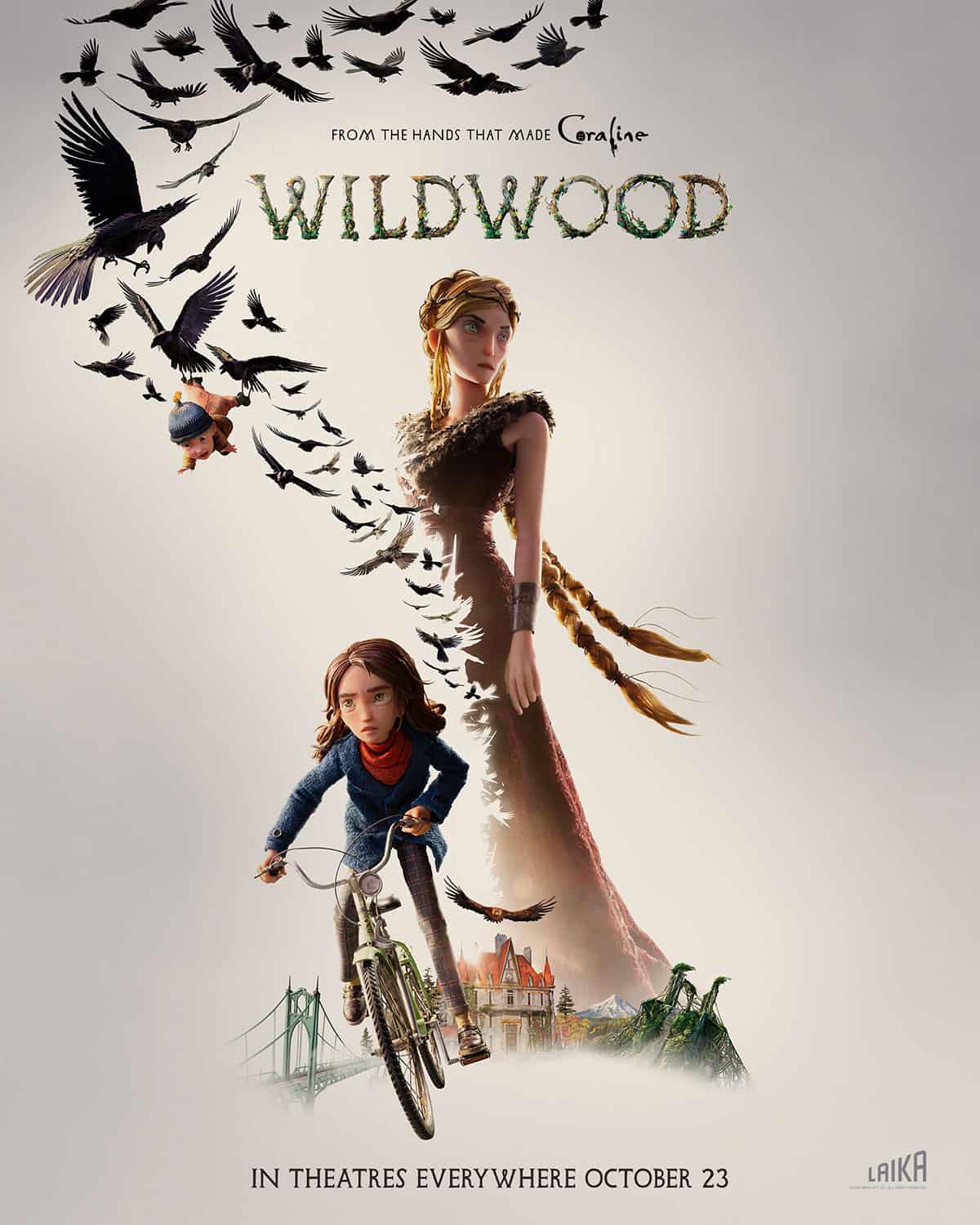

LAIKA Studios’ Wildwood, directed by Travis Knight, is perhaps the most technically impressive stop-motion film ever made. The people behind Wildwood have let loose a battle cry against machine-generated shortcuts, AI artistic theft, and the general “enslopification” of everything modern. LAIKA’s war for authentic human craft echoes that of the Bandits and armed woodland creatures in the film’s climactic sequence. On technical grounds, this film is a triumph. Morally and narratively, though, the results are a bit murkier. Consequently, Wildwood is a film that I can recommend to any cinephile, but not to every juvenile.
In the film’s very first scene, a boy living in a mansion beyond the magical borders of the Impassible Wilderness—which are just outside Portland—shuts himself in his room, strips off his clothing, and hurls himself from a balcony, but not before tearing out his own heart, revealed to be a bit of clockwork. Yes, this animated film opens with a nude adolescent android puppet suicide—which is not a clause I’d ever expected to type. Meanwhile, in nearby Portland, animated in loving detail down to its famous Powell’s Bookstore (with “Drag Queen Story Hour” visible on the marquee), its fraying, hipster-haunted streets, and its picturesque St. Johns Bridge, another adolescent faces a crisis. After disobeying her parents by taking her toddler brother Mac around town, Prue McKeel must brave the Impassible Wilderness to recover him from a murder of crows. She’s joined by Curtis Mehlberg, a cowardly and inoffensive male acquaintance, and the two are soon separated and swept up into the magical politics within that realm. There’s quite a bit to discuss, but before doing so, let us take a moment to appreciate the sheer wizardry behind this movie.
Inside its massive physical studio, LAIKA Studios built 136 locations and 231 puppets, including “54 hero characters… each and every one of them… engineered and costumed like a bespoke work of art.” An eagle character (voiced by Angela Bassett) sported thousands of hand-installed feathers. Newer technologies like 3D printing were utilized to allow the puppet faces to be switched out, affording a greater range of expression, and tens of thousands of these faces had to be printed. Some of the puppets even featured small motors within their chests to simulate respiration. But these production details only scratch the surface. The film includes huge battles, elaborate aerial sequences, and the lifelike movements of wind, water, plants, and animals. While CG was used to remove rigs and the puppeteers’ hands as well as to fill out and blend complicated elements, everything you’re seeing on screen has its basis in physical models, hand-built, painted, and painstakingly positioned over six years. While the movie was sixteen years in overall production, filming took almost seven, with days of footage often yielding mere seconds of screentime. Special puppets or puppet groups like the General (an eagle) and the murder of crows required their own dedicated teams and years of work. The result is a breathtaking, beautiful spectacle.
Stylistically and mythically, the film, which is based on a novel by Decemberists frontman Colin Meloy, seems to draw upon both old folklore and modern fantasy films. Though I’ve not read Meloy’s novel for comparison, the story onscreen has notes of Willow, The Labyrinth, Avatar, “Rumpelstiltskin,” “The Snow Queen,” The Nutcracker, The Chronicles of Narnia, Alice in Wonderland, and more, and its imagery recalls elements from many of these. Within the Impassible Wilderness are talking animals, magic ivy, vaguely celtic warriors and druids, automobiles, bureaucrats, and a giant, omniscient tree. Portland is also sufficiently detailed (and weird) as to feel realistic (though that realism does not extend to the army of homeless and addicted who currently line its sidewalks, as I witnessed during a recent trip). These elements in combination make for an intoxicating sensory experience which has the benefit of feeling rooted in a real place. Unfortunately, some of Wildwood’s brand of realism also precludes as wide a viewership as its artistry would otherwise merit.
Wildwood is quite violent, featuring an adolescent suicide (of sorts), beheadings, impalements, an eye-gouging, blood splatters, and the persistent threat of the sacrifice of a human baby. While I appreciated the film’s surprisingly traditional iconographic assignment of good and evil beasts and its explicit identification of witchcraft and black magic as “satanic,” this might be a tough movie to watch with a child under ten. Meanwhile, the filmmakers are at obvious pains to be “inclusive” in all the ways that term is currently used. The spiritual backdrop is vaguely animistic, though happily Meloy’s mythology does not indulge in that Manichean dualism which is such a common feature of modern fantasy. In the main story, good and evil are not equal and opposite forces here. Evil is portrayed as a corruption or shadow of goodness. This distinction doesn’t extend to the magical ivy, however, which seems to be beyond good and evil: an amoral, chaotic embodiment of Mother Nature’s capacity for creativity and destruction.
Narratively, the film is a muddle. I had problems with its exposition, pacing, and characterization. The trick of any speculative fiction is to drop the “normal” characters into the abnormal place and let the narrative organically reveal the rules and parallel logic of that strange new land. This takes time, and for it to work, the weird place must have a certain cohesion so that causality can operate in a believable manner in-world and so that threats or exceptions feel weighty and somehow universal, despite the exotic backdrop, rather than feeling like just more expository world-building. In Wildwood, new elements of setting and new characters and creature-types are introduced almost simultaneously with new plot complications, giving the story and world an ad hoc quality. It would have been preferable, once Prue and Curtis separated, to give them time to live in their respective regions of the Impassible Wood. Instead, strange new elements are introduced as norms and exceptions at almost the same moment, which lends a “just because” or “and then” quality to the storytelling. We the viewers don’t have enough of a sense of how things are supposed to work before some inciting incident throws a wrench into those works.
To take a few examples, we’re introduced to the South Wood as a region or principality where humans and talking animals live together under some kind of vague bureaucracy where lots of paperwork is always being done, where “outsiders” are forbidden, and where the governor and his lackey are presented as a parody of—something; it’s not clear what, other than the fact that we’re not supposed to like them. While there, characters fly in to tell Prue what’s really going on, but we the viewers hardly have a chance to learn what it was that seemed to be going on. Then there’s the General, an eagle who refuses to help, then suddenly helps, with no explanation for the plot-moving change of heart. There are a dozen other small instances of this sort of thing. The narrative continually assumes a familiarity—almost a chumminess—with the audience that it hasn’t earned. In multiple instances, particularly when fuzzy talking creatures we’d barely met began expositing on the great magical things at stake, the threats to their communities, the need to put aside old quarrels, etc., this reviewer felt like Thanos confronted by the Wanda Maximoff in Endgame (Wanda: “You took everything from me!” Thanos: “I don’t even know who you are…”). This bleeds into the film’s general problems with characterization, which I’ll touch on only briefly.
First, Prue McKeel is supposed to be thirteen but looks and behaves like a world-weary Tori Amos impersonator. While her motivations are strong—first finding her baby brother, then saving him from being murdered with a dagger in an evil ritual—her personality remains largely static and strangely unmoved by any of the magical goings-on around her up until the point where she unlocks a hidden power. (This kind of character always unlocks a hidden power.) Curtis Mehlberg is established as a nerd who only likes to play at adventure, but who will need to step into the role of hero. Yet when he’s forced to step up, to fight in defense of another, he nearly lets his friend die at a villain’s hands, and no change seems to have been effected in him or in his understanding of the world. This, even though Wildwood goes out of its way to explain that sometimes fighting is actually necessary, only to undercut this point by asking us to empathize with Curtis’s waffling, effeminate niceness, as if any kind of masculine agency on his part would make us doubt his goodness or detract from Prue’s decisiveness. Certain character types are allowed to be fierce, decisive, dare I say manly, but the boy character who secretly longs to be a warrior is kept carefully neutered. In this he resembles Prue’s father, an equally placid wet noodle whose actions or inactions should have consequences but ultimately don’t. In sum, though the film is a technical masterpiece, its writing does not rise about the level of a B-tier animated film, its worldbuilding feels choppy, and its characters move through the plot rather than moving it—with one exception.
The Dowager Governess Alexandra is a strong, complex character. As a grieving mother who turned to black magic, she’s truly evil because her choices are evil and because she refuses multiple chances to turn back from the course laid by those choices. Still, we feel some empathy for her, and there’s a madness and grief beneath the surface which is partly driving her choices. But ultimately, her calculated behavior and capacity for deception demonstrate her culpability. Her character design and in particular her headdress recall Willow’s evil queen Bavmorda, but her motivations make her partly an Isis or Orpheus character, driven by love to do the impossible in order to recover the beloved, no matter what the cost. Happily, the film never waffles on her villain-status, though it does seem confused about how to best reconcile its progressive messaging with its more traditional hero-villain iconography. Thus, after the aforementioned suicide where it’s revealed that Alexandra’s son is an automation, an angry crowd led by what is presumably an ambitious straight white male banishes her for witchcraft. It’s clear we viewers are supposed to dislike this man (the paper-pushing bureaucrat of later scenes), and yet we’re also supposed to dislike the witch-governess because she’s a witch. So which is it, Wildwood? This contradiction recalls the aforementioned muddle about whether there is or isn’t a time to kill, and the parallel muddle about what boys are and are not allowed to do. One can’t help but perceive an underlying moral tug-of-war between the film’s progressive relativism and its more traditionalist genre requirements.
In sum, Wildwood is a film that many people should see for the sake of its glorious artistry and the real life technical magic that brought it to life; but it’s not a film for every audience. Its violence makes it a tough watch for younger audiences while its ideological commitments, worn on its sleeve, tend to undermine its value as a fairy tale. Indeed, despite its wonderful imagery and the triumph of the human person over the machine to which its human craft bears witness, there’s little sense of the transcendent and ethereal in the story itself. When the main protagonist, Prue McKeel, is too “sophisticated” to experience wonder, how are we viewers supposed to? Yet despite this, I found myself in awe of the film’s physical majesty, and grateful that at least some filmmakers, whatever their philosophical deficiencies, still possess the artistic integrity to bet on the power of human creativity over that terrible contemporary black magic wielded by our own living machines.