

The Heights is not a “research institution”; our mission is not to discover new things but rather to teach students what our civilization already knows. Nonetheless, because we are a community of busy people who tend to be especially busy at this time of year, I feel an obligation to share a new method of time management.
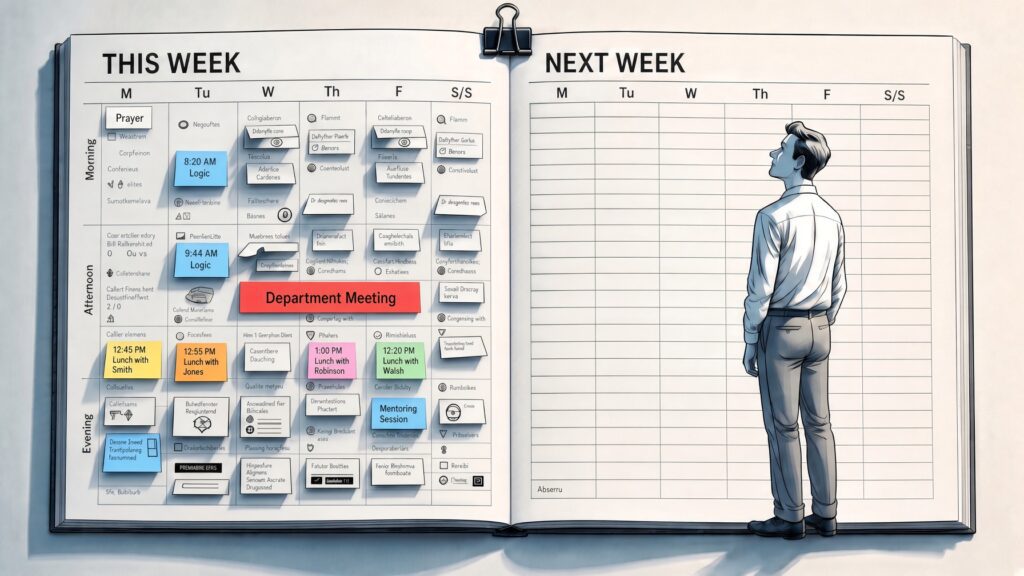
I call it “Next-Level Time Management,” and it is built on this basic insight: whatever unit of time you are working in, you will have more time available in the next unit than you have (left) in this unit. So, for example, you will have more time tomorrow than you have (left) today; more time next week than you have (left) this week; more time next month, next semester, next year, etc. This means, logically, that you have a much better chance of doing more with the time you have if you move tasks from today to tomorrow, from this week to next week, and so on. You can’t create more time for the work, so move the work to where there’s more time.
Beyond procrastination
Many parents and teachers reading this are thinking, “What a fraud! You didn’t discover this! One of my kids used it on me just yesterday to avoid finishing his English essay!” (or taking out the trash, or whatever). But what you’re describing is mere procrastination, and procrastination is basic time management, which kids understand from birth. Next-Level Time Management is a method for doing more rather than less. We do this by culling the tasks that cannot possibly be completed in the overcommitted present and bumping those tasks into a future that may still be largely unspoken for. So whereas procrastination puts off until tomorrow the things that can be done today, Next-Level Time Management puts off until tomorrow the things that can’t be done today. Consider these examples:
- Smith is a doctor whose services are in high demand because of his training and experience with a relatively new medical procedure called a quodlibectomy. Smith can only do so many quodlibectomies in a week without sacrificing quality. But when faced with this excess demand, Smith doesn’t just turn away patients with nagging pains in their quodlibets; he schedules them for next week, or the week after that, etc..
- Jones is a talented writer who is regularly asked to ghostwrite memoirs for politicians who wish to appear smarter, wiser, deeper, or more relatable than they really are. The number of politicians who could benefit from Jones’s services is obviously far greater than Jones can handle by himself in the present moment. But with four years between presidential primaries, Jones can write an astonishing number of bad but lucrative books each cycle if he can just get each politician to settle for a manuscript next month instead of this one.
“But wait,” you say: “Doesn’t that mean that next week will be just as busy as this week was? Aren’t you just prolonging the problem?” I have come to think that’s an unduly negative way to frame what’s happening. I would say rather that Next-Level Time Management expands the available resources for solving your workload problems, by deferring the surplus tasks from the current time period to a new time period in which there is always more time available. Consider: by the time next week becomes “this week,” you will have a fresh 168 hours. And note well, the advantage of next week’s “this week” is not merely that it has more time than this week’s “this week” has (left) in it; next week’s “this week” will also have its very own “next week,” into which some tasks may need to be deferred.
Some ground rules
You do need to set some ground rules for yourself. First and foremost, Next-Level Time Management is for deferring the making of new commitments, not the keeping of old ones. If this week is already overcommitted, then you may just be in for a rough week, because you can’t default on this week’s commitments without becoming the kind of person whose commitments aren’t worth very much. Don’t become that person. You want, instead, to let your yes mean yes and your no mean no—which will often require you to say no for this week and yes for next.
The second ground rule for Next-Level Time Management is that you must be realistic about what you can accomplish next week. Your experience this week should be instructive. You may be disappointed in what you were able to accomplish this week, and you can by all means try to do better next week. But it would be rash to presume that you will acquire some new superpower between now and then; it would be more prudent to presume instead that Next Week’s You will be, at best, just a little bit better than This Week’s You. You may need to say to Next Week’s You, as the legendary Lou Holtz said to his football team, “We’re gonna get in two good hours of practice even if it takes six hours.”
Too good to be true?
Before you object that this seems like some sort of Ponzi scheme—today’s work slips to tomorrow, and tomorrow’s to the next day, and so on ad infinitum—let me point out that ad infinitum is exactly what this is not—because we all die eventually. The essence of a true Ponzi scheme is the fraudulent pretense that it can go on forever. No such deceit is even possible with Next-Level Time Management, because no one can claim to be surprised by our mortality. All of our future commitments carry the implicit reservation, “provided I’m still alive.” Inevitably, death will leave some of our projects unfinished. But this is scarcely even a drawback, as far as time management goes, because nearly all of these unfinished projects fall into just two categories: they become either (1) Someone Else’s Problem, or (2) No Problem at All. (There is a third category, which we can call “Things to Discuss with St. Peter,” but the only projects in that category are loving God and loving our neighbors, neither of which is primarily a matter of time management.)
It is of course quite true that next week simply does not have more time than this week. Every day has twenty-four hours, every week has seven days, and so on. But there is one respect in which next week will almost certainly be very different from this week (even if you’ll still be the same old you), and it’s one of the real advantages of this whole approach: next week’s time is far more resistant to being wasted. Think of the time you’ve wasted this week, and the useless activities that occupied that time. Now: have you scheduled any blocks of time next week to do those things? Of course you haven’t, because those are things not worth doing. Think how much richer next week will be if it is entirely free of the things on which you wasted time this week! Think how great it would be to spend a whole week on the things you consciously decided to do next week, instead of so many of the things you aimlessly, even mindlessly, ended up doing this week. That is what it would be like to take time management to the next level. You may not have managed to stay off of TikTok this week, but you have it in your power to make yourself far too busy for it next week, if you fill next week with better projects.
To put it another way: your finitude is your friend; it is what makes “Next-Level Time Management” a helpful corrective to our unproductive busy-ness instead of merely a catchy title for a puckish essay about time management. Recognize that your hours per day, your days per week, and your weeks per lifetime are all finite. Recognize that what you can do with those hours is also finite. And now finally, recognize that you are in charge of what you do with that time, but not how much time you have. Here we see that death, which can seem to us like such an unfortunate glitch in the whole system, can actually be a great regulator of the commitments we make and keep. It can be for us the key to discerning the difference between what is worth doing, and what is not.
How can we discern the difference better? That is too big a topic for this essay. Maybe I’ll tackle it in the next one.
Mark Grannis teaches logic and history at The Heights. His latest book is Should You Go to Law School? Knowing How to Know. His latest article is this one, which was in fact late.