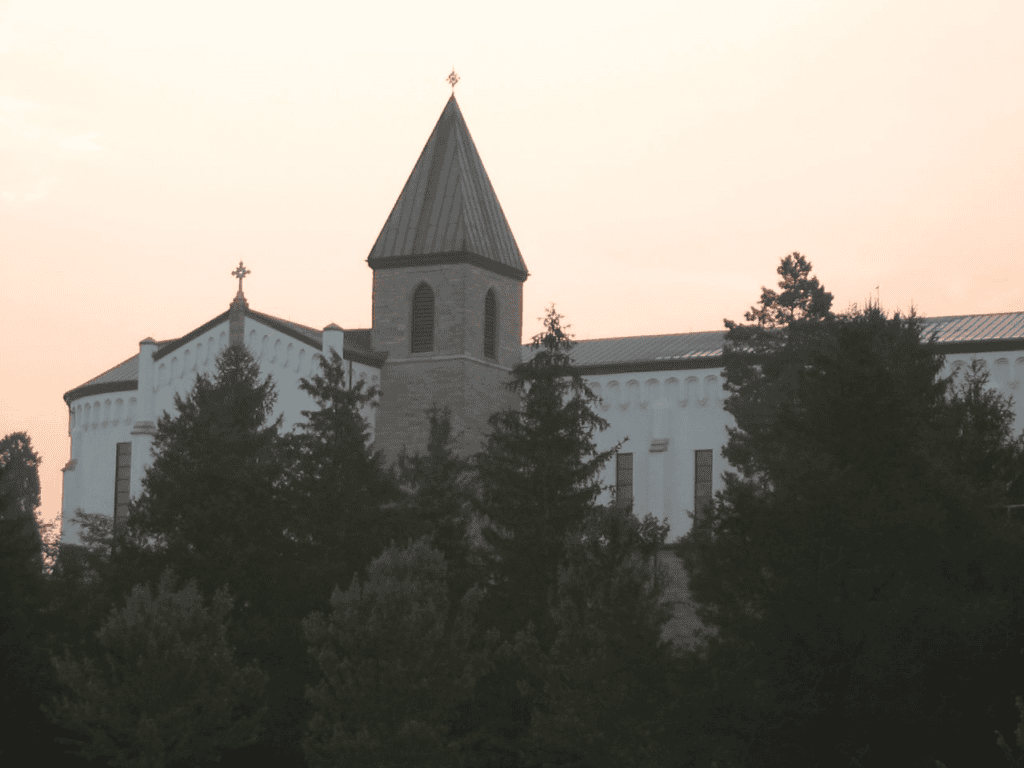

The real is a closely woven fabric.
—Maurice Merleau-Ponty
In the fascinating life of Thomas Merton (1915-1968), we can see a biographical arc intertwining many themes and realities, traditional and modern. As a young adult, Merton was fairly typical of an intellectually-inclined college student in the first half of the twentieth century, but in his later vocation as a Trappist monk, he was deeply formed in the pre-modern outlook of the Cistercian order. Even then, he was conscious to a high degree of the prestige of the literary profession that had its share of glamor for the chosen few. This is suggested, I think, by his decision to publish under his own name, and not the name he was given by his abbot as a member of the Abbey of Gethsemani, outside of Louisville, Kentucky.
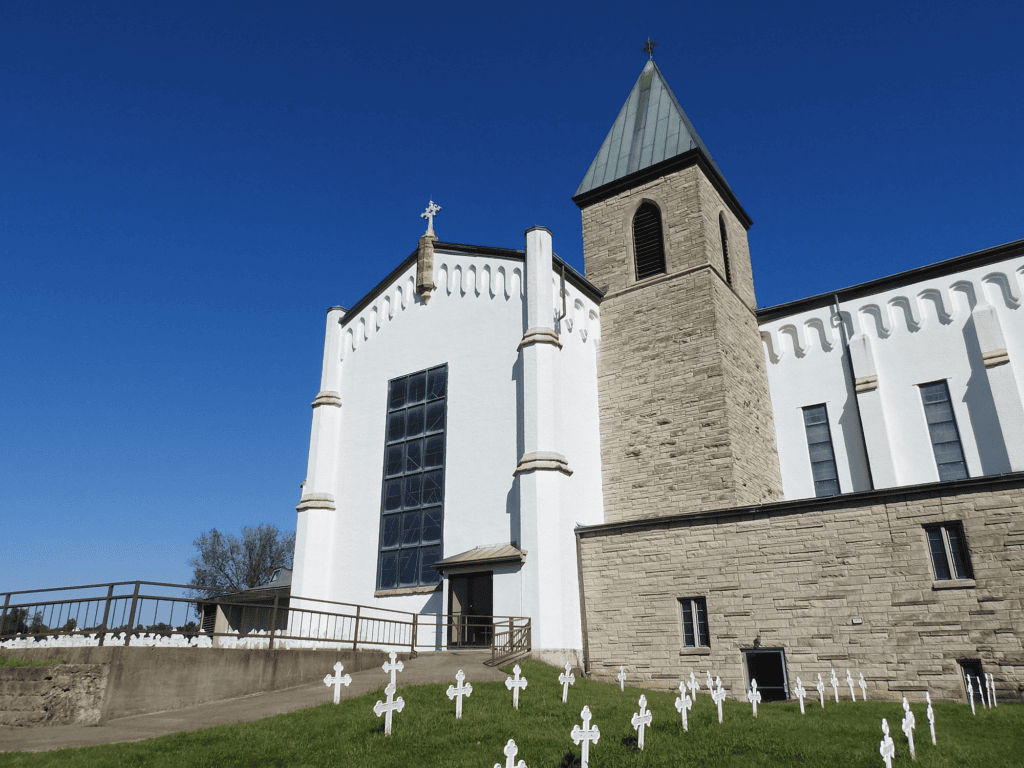
As a writer, he yearned for success; as a monastic, he sought to disappear in Christ. In this way, Merton is something of a composite figure, yet one not statically holding together disparate outlooks so much as a protagonist trying to work out how he can make alive in his own life eternal truths. When Merton read Thoreau’s Walden in 1950, certainly a text outside monastic or Catholic tradition, it confirmed his tendency to be attuned to the rhythms of the world, especially amid nature, his soul alight with faith, clear as a pane of glass. He’s something of a hybrid: Catholic in a cultural and confessional sense.
For these reasons, among others, Merton is an invaluable guide to any person seeking to formulate his or her vision of life in words rapt with passion and love, leading to insight into the here and now informed by the transcendental realities of the Gospel.
Let’s explore a little who Merton was and ponder one example of his writing: a passage from his journal so wide awake to the world we can almost hear the crickets and finches of the Kentucky night in which he waited and watched.
Thomas Merton was born in France on January 31, 1915, “in the year of a great war, and down in the shadow of some French mountains on the borders of Spain,” he would memorably write in his autobiography, The Seven Storey Mountain (1948). His father, from New Zealand, was an accomplished artist, his mother a native New Yorker who died when Merton was six years old. He moved around with his father—to Bermuda and Massachusetts, among other places—ending up in a preparatory school in Ealing, England, where he learned to box and refrain from public prayer at school. He won a place at Clare College, Cambridge, and went up in the autumn of 1933.
Drinking and dancing took the place of study, and he got into some sort of legal difficulty from either fathering a child (his version), or breaking off an engagement with the same woman (at the time, possibly incurring serious legal consequences). Visiting his godfather in New York, he decided to ditch his English dreams and enroll in Columbia University. There he blended into the literary scene, making a number of friends, including Robert Lax, later an accomplished poet, along with Robert Giroux, future co-founder of the publishing house Farrar, Straus and Giroux.
By the time he was doing graduate work in literature at Columbia, he had become a Catholic. After having the prospect of a vocation to the Franciscans brutally dismissed by a priest in confession, he taught at St. Bonaventure College in New York state, trying to find his spiritual path. That soon led to the Abbey of Our Lady of Gethsemani in Kentucky. Accepted as a postulant there in 1941, he would be ordained a priest and live in the abbey as a Cistercian monk until his death at a conference in Bangkok, Thailand, in 1968.
Merton’s monastic life was fruitful: he published 50 books and 300 articles, and his autobiography alone has reached millions of readers. His writing life also made his monastery more popular worldwide, as well as providing significant increases in yearly income. He is among a handful of Catholic writers—Evelyn Waugh, Graham Greene, Flannery O’Connor, Walker Percy, among others—in the mid-twentieth century who influenced the culture by virtue of their sheer literary excellence. Merton’s first publication was Thirty Poems (1944), with A Man in the Divided Sea (1946) reissuing the first book with an additional 56 poems. The Seven Storey Mountain came out in 1948 and was an instant bestseller.
The Sign of Jonas (1953) is a journal, a “collection of personal notes and meditations” taken during his first five years at the Abbey of Gethesemani. The years 1946 to 1952 cover Merton’s path through the life of a monastic up to his priestly ordination and work as a guide to the novices and other younger monks. Even if you aren’t Catholic or particularly religious, you can notice the sharp tang of realism as Merton chronicles his life “of prayer and of penance, of liturgy, study, and manual labor.” This is a life lived close to the ground, literally. (Though Merton was not very handy when it came to working with farm machinery—he once drove a tractor through a barn wall.)
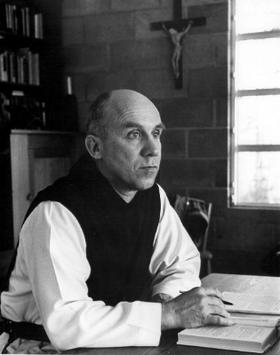

The valley in Kentucky where the monastery was built in the nineteenth-century “is a few miles from the place where Abraham Lincoln was born… and has, as its background, the same landscape of steep wooded hills, broad fields of corn, and rocky creeks where the boy Lincoln hunted and read and meditated by the fire. Lincoln’s first great teacher is buried in the cemetery outside the monastery gate.” As mentioned, Merton’s reflections on his life at the abbey (and his years living in the hermitage on the abbey grounds) show the distinct influence of Thoreau’s years at Walden Pond in the 1840s. What Merton lacks as a naturalist compared to Thoreau, he compensates with his lyric evocations of the spiritual dimensions of silence amid the natural world. Merton walked in the world acutely aware of its intimacy with the divine.
The epilogue of The Sign of Jonas is titled “Fire Watch, July 4, 1952.” It is also often cited as a stand-alone masterpiece of poetic expression and spiritual depth.
On this evening at the abbey, Merton has “fire watch”—his job is to wander the abbey’s main buildings searching for fire hazards with a clock, a punch card (to record his steps along a set route), a flashlight, and sneakers, so as not to wake the sleeping monks. On this hot July night, Merton’s walk through the abbey becomes a journey through his own life as a monastic, culminating in a deeper appreciation of the night as an icon of God’s own infinite mystery. Finally, Merton arrives at the top of the belfry of the church’s tower, poised, recollected, alive to the least gust of air coming out of the Kentucky summer night:
And now my whole being breathes the wind which blows through the belfry, and my hand is on the door through which I can see the heavens. The door swings out on a vast sea of darkness and of prayer. Will it come like this, the moment of my death? Will you open a door upon the great forest and set my feet upon a ladder under the moon, and take me out among the stars? The roof glisters under my feet, this long metal roof facing the forest and the hills, where I stand higher than the treetops and walk upon the shining air.
This is the beginning of the epilogue’s extraordinarily rich language working on many levels. Merton’s religious searching is supernatural, of course, but also deeply human. A few things to note: Merton weaves together natural and supernatural strands of existence: the summer wind at night and the Holy Spirit’s embracing of all being; the opening door at the top of the belfry and the entrance into the mystery of prayer; his walking on the “shining air” evoking the supernatural nature of the entire experience. Merton proceeds to question the Lord, mindful of the ways the psalmist conversed with God over the incalculable mysteries of life. But here Merton somehow merges various voices into one lyric thread. We hear the psalmist alongside the observant gaze of Thoreau and the Romantic poets: “Mists of damp heat rise out of the fields around the sleeping abbey. The whole valley is flooded with moonlight and I can count the southern hills beyond the water tank, and almost number the trees of the forest to the north. Now the whole chorus of living beings rises up out of the world beneath my feet….” In a touching way of prayerful intimacy, Merton asks God if he “sees” the wood, “…do you hear the rumor of their loneliness? Do you behold their loneliness?” The answer comes quickly: “There is no leaf that is not in your care.”
But there is more than the sounds of life rising up to the “frozen stars” that night in the Kentucky fields and rolling hills. There is also the vast silence of God’s mystery.
This leads Merton to echo the voice of the poet William Blake: “Eternity is in the present. Eternity is in the palm of the hand. Eternity is a seed of fire.” Here the poetic close of the journal, from the great, moonlit height of the church’s belfry, weaves time through intimations of eternity as the deeper reality of the latter opens before Merton’s prayer: “The things of Time are in connivance with eternity.” With a love for creation’s vast intricate wealth, Merton is a guide for all of us, learning to perceive the master’s hand in each brushstroke of his creation, including, not least, in the details of our own lives, their twists and turns, their struggles and graces.
.jpg)
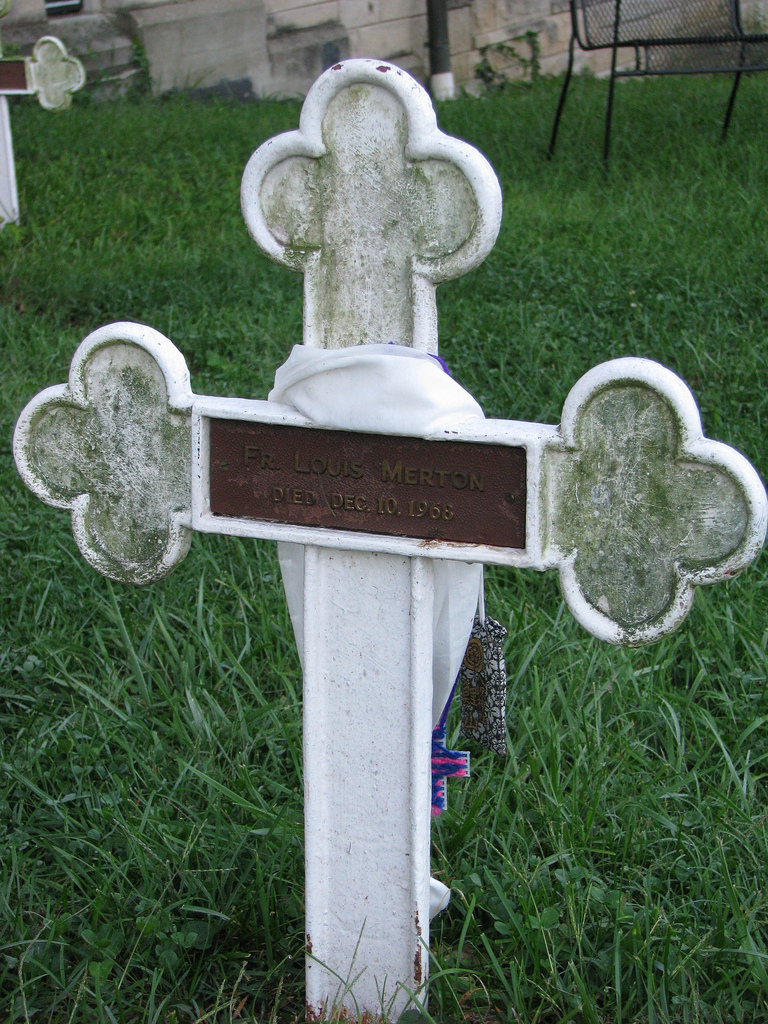
Thomas Merton is one of those guides who teach us that we learn to know what to do by loving what is. And that journey begins and ends with the author of all things in heaven and earth. This journey of Merton’s life also put his writing aspirations in order, in that he came to know writing as an act of service for his order and for the Church. It was not an easy path to this realization, of course, which had its share of feeling utterly lost in the desert. But as the final image of his journal puts it, Merton knew the Lord can provide where nothing else can, if we learn to see with the eyes of Faith:
“There are drops of dew that show like sapphires in the grass as soon as the great sun appears, and leaves stir behind the hushed flight of an escaping dove.”