

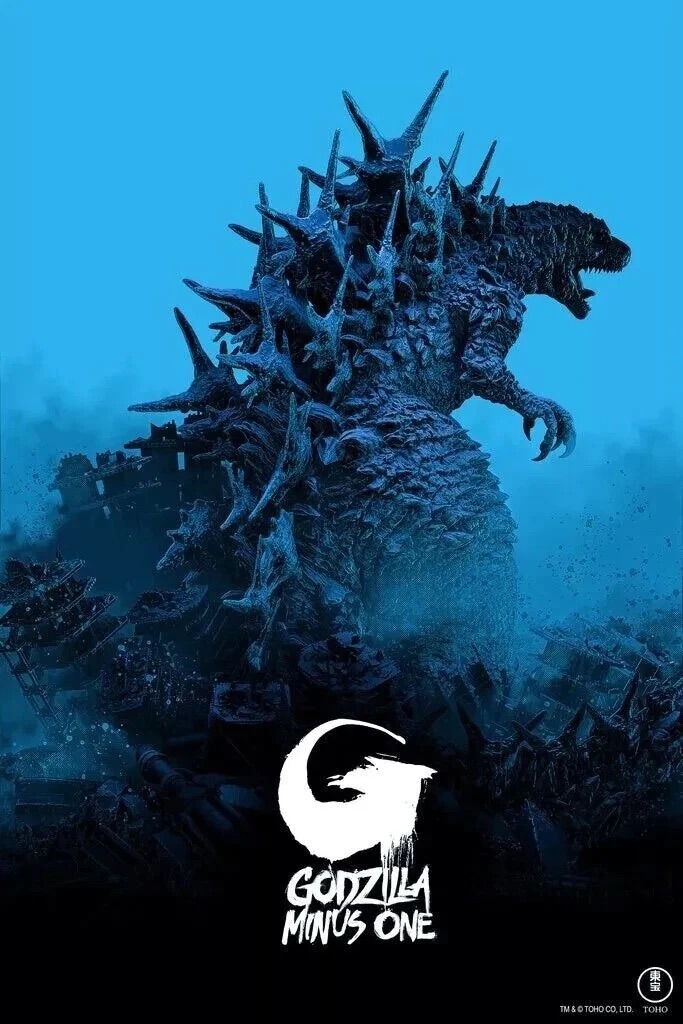

2023’s Japanese film Godzilla Minus One is more than a monster flick—it’s a true family movie. Not to be confused with CGI-heavy American Monsterverse films like Godzilla x Kong (2024), GMO is a piece of old-fashioned movie magic. What it lacks in budget—the film was made for a mere $15 million!—it more than compensates for in story, acting, and an incredible use of budget-conscious effects that somehow look better than Warner Bros.’ $150 million popcorn flicks. And yes, GMO is a popcorn flick, but it’s so much more. The movie offers profound meditations on such themes as war and grief, guilt and honor, and on the drama of the human family.
The story opens in the last days (for Japan) of World War II, when kamikaze pilot Kōichi Shikishima lands on Odo Island for repairs. There’s nothing wrong with his plane, but it’s soon revealed that Shikishima has “failed” in his (at that point, useless) mission to crash-dive to a certain death. While on Odo, a creature attacks and begins killing the crew. Once more, Shikishima has an opportunity to do his duty, and once more he fails. A mechanic who survived the attack later drops photos of his fellow workers in Shikishima’s lap, relics of his failure to act.
Shikishima returns to his home in Tokyo to find it a virtual hellscape, with war survivors living in the bombed-out remnants of a once-great city. His parents are dead, and Shikishima’s very survival as a kamikaze who returned makes him a sort of walking scarlet letter. While haunted by guilt and frequent nightmares, fate puts him in the path of a pretty young woman, Noriko, and a found baby (Akiko) for whom she’s trying to provide. Together, the three of them form a Josephite family. Noriko clearly loves him, and he loves both her and the growing child Akiko, but Shikishima cannot allow himself to be loved. Haunted by a complex mixture of guilt and the very desire for life that accounted for it, Shikishima cannot move forward. The way he provides for Noriko as a chaste “husband” and for Akiko as a father, all while allowing himself no comfort—or forgiveness—for his perceived guilt, proves that Shikishima truly is honorable, even if he can’t see it.
Guilt seeks him out in the form of the same creature, now titanic, that he might have dispatched when it was smaller. The Godzilla of this film should not be confused with the eco-protector of recent Warner Bros. films. This Godzilla is evil: destructive, cruel, and genuinely frightening. Nor is this Godzilla the classic films’ Nemesis character—indifferently embodying un-addressed social evils, the atomic bomb, and so forth. The Godzilla of GMO is downright malicious, yet his malice is also refreshing, because it draws the moral lines clearly. On one side: Shikishima’s family, both immediate and societal. On the other: hopelessness, guilt, death.
Defeating such an enemy requires more than just courage. It will require Shikishima to go back to the roots of his own guilt and face the question that not only haunts him, but in some way has helped fuel the monster’s growth: What form ought manly courage take? Stated another way: What is the difference between sacrifice and seppuku?
I won’t spoil the resolution, but I can guarantee it’ll put a smile on your face; perhaps a tear in your eye. Though the movie’s quiet moments are among its best, the final confrontation is eminently satisfying. When the brass and strings of the classic Godzilla theme finally kick-in, goosebumps are sure to follow.
Godzilla Minus One gets its name from the mental and emotional disposition of the Japanese people after the second World War, after the Bomb and its effects; yet the film is not overtly political and feels more critical of the devastating consequences of modern warfare and the stupidity of bureaucracies in general—whether Japanese or American—than of any particular state or its actions. There is no bitterness here, only sorrow at the anonymity and futility of mass death. And the film brings focus to war’s sometimes underappreciated victims, namely social cohesion and the family unit. Despite these grim considerations, the movie is appropriate for most audiences. Parents should expect some frightening scenes of destruction and death (though with little or no blood), and one fleeting reference to a desperate form of employment (which will go over children’s heads). GMO has no sex and little if any language. Finally, this film should only be watched as presented in theaters, that is, in Japanese with English subtitles.
For families looking for a genuinely good movie that combines some healthy scares with an uplifting ending, Godzilla Minus One is an excellent choice. It packs enough action, emotion, and depth to engage the whole family, offers admirable and realistic portrayals of masculine and feminine virtues, and it celebrates—without preaching—values that are important to all decent people. Highly recommended.