

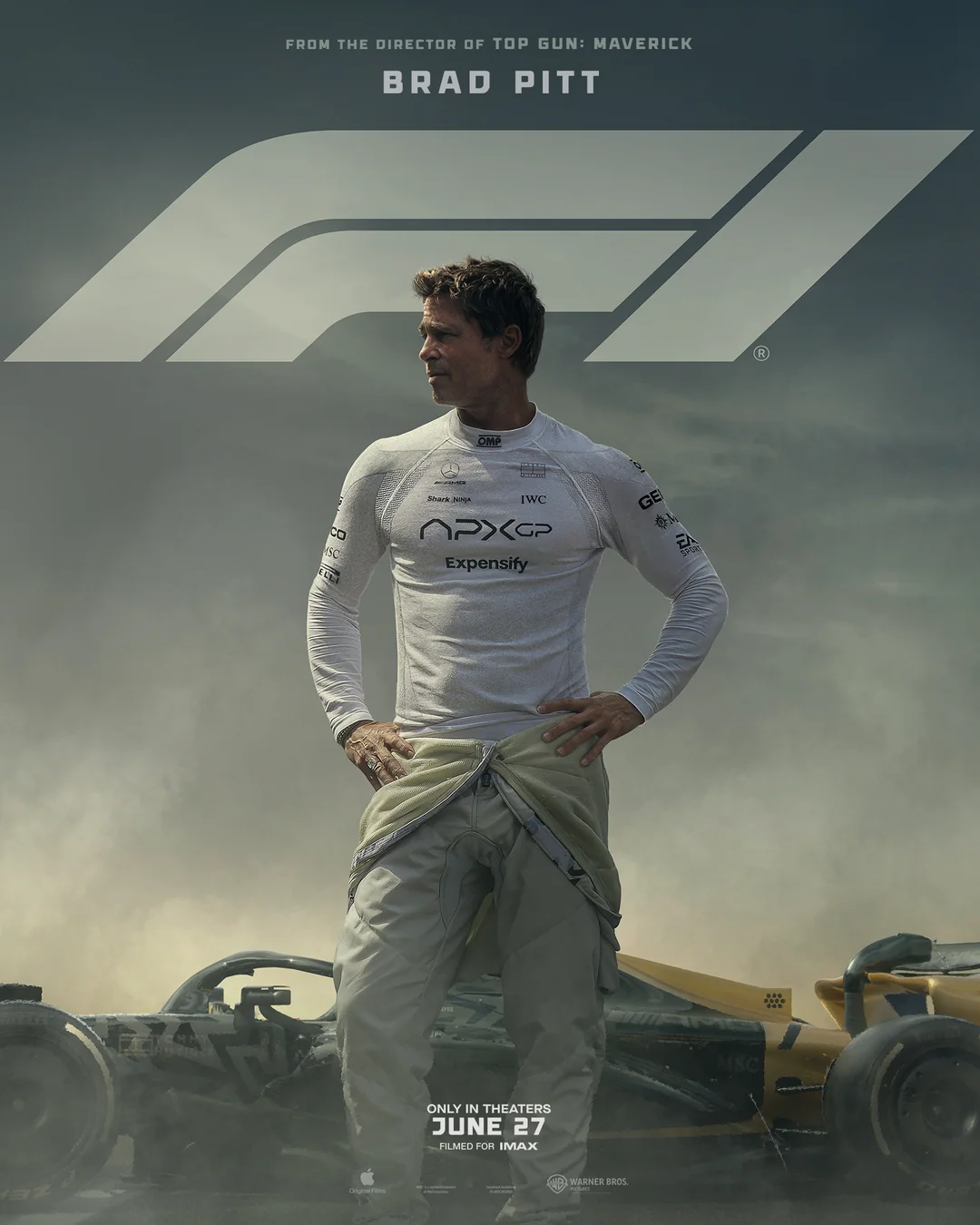

If the social media “manosphere” became incarnate as a movie, that movie would be F1. Not so much a story as a series of “manly” tropes stitched together by plot armor and neon-colored dental floss, this Jerry Bruckheimer-produced flim-flam construction seems to have as its primary targets twenty-something meatheads and middle-aged male divorcees living out their glory days (or, more likely, their could-have-would-have days) in their imaginations. The protagonist is an empty shell, the supporting characters mostly plot devices, and the plot itself is so agonizingly familiar as to make F1 an unintentional parody of itself.
Brad Pitt plays Sonny Hayes, a washed-up racing rambler who’s fallen far from his glory days, but who’s also (somehow) quicker, craftier, and wiser than entire F1 racing teams—and their drivers, investors, and staff from around the world. In the midst of his normal occupations of living in a van and wandering from town to town while picking up the odd racing job, winning easily, doing pushups, and other masculine etceteras, a former racing buddy, Ruben Cervantes (Javier Bardem), swoops in to recruit him for the proverbial last chance to redeem himself, and save the failing APXGP Formula 1 team while he’s at it. Naturally, Sonny Hayes refuses. And naturally, he quickly un-refuses so the movie can happen. Of course, APX’s other driver resents (and quietly fears) this old-school expert. As one would expect, Hayes’ cowboy ways throw a wrench into APX’s existing plans. To be sure, he’s a bit of a jerk, but his reckless approach to winning, his experience-forged feel for race cars, and—I guess—his good looks, guarantee his eventual victory.
If you’re wondering just how many standard sports or action movie tropes this film manages to cram in, the answer is “Yes.” Sonny Hayes walks towards us from the horizon with his dufflebag over his shoulder. Sonny Hayes does lots and lots of pushups and pullups, usually with his shirt off so we can see his muscles and the tattoos that prove his storied personal history. Sonny Hayes is constantly honing his reflexes (in old school ways) by throwing playing cards into hats, bouncing balls with two hands, and jogging on the real life actual ground. He plays poker and always wins, smiles boyishly while staring wistfully into the distance, and all of his “mistakes” are really game-changing discoveries. Characters around him, both male and female, are constantly putting their feet down and drawing principled lines in the sand, only to surrender to his indomitable (but understated) will, or else to his rascally charm. A washout scene, a you’re-off-the-team scene, an okay-I-guess-you’re-back-on-the-team scene, an almost-fatal-crash scene, a love scene, a young-buck-learns-to-appreciate-old-man scene: F1 has it all! Near the end of the film, Sonny Hayes even asks his current female conquest if he’ll “see [her] down the road” before he rides off into the proverbial sunset.
As for the score, it’s allegedly the work of the great Hans Zimmer, though you can hardly tell amidst the cacophonous soup of ADHD-inducing filler songs, a mixture of classic rock and frenetic pop presumably meant to reflect the old-meets-new theme, or perhaps just there to keep the audience distracted while the film hops from one predictable scene to the next. Because the plot often turns upon some unintuitive technicality of Formula 1 racing rules, there are ample instances of characters, including sports commentators, discussing these rules out loud, usually just before a rule becomes relevant to the plot. The background noise of these exposition dumps competes with the background noise of Zimmer’s occasional soundtrack, the incessant blaring music, and the visual noise of neverending camera cuts, and brightly-colored product placements. (One would hardly be surprised if the internal advertisements alone were sufficient to cover F1’s entire budget.)
On a more serious note, this shallow husk of a film presents a caricatured view of manliness. Sonny Hayes embodies Frank Sinatra’s hedonistic anthem “I Did It My Way,” but the movie also wants us to believe that Hayes carries within his bosom the gravity and accumulated wisdom of a John Chisum or a Rooster Cogburn. It promotes the lie that a man can be completely unattached and also heroic. In reality, the primary difference between a boy and a man is that the latter takes the lives and happiness of others on his shoulders and leaves them there until they kill him. Meanwhile, boys—and man-boys like Sonny Hayes—act primarily to satisfy their own immediate goals and desires, and if those happen to coincide with yours, well, how nice for you! Near the end of the film, Hayes states that he is more than willing to die for the chance to end his life in what athletes call “a state of flow,” though Sonny calls it “flying.” “I’ll take that life a thousand times over,” he says. This “flying” is Sonny Hayes’ one true god, a god he’ll keep pursuing forever, accompanied only by his nifty camper van and his cool red sunglasses. When I wasn’t laughing at its preposterous predictability, this film made me sad. Sad for Hollywood, and sad, even, for Brad Pitt, who seemingly embodies his character’s view of manhood with an uncomfortable, unintentional irony.
For those searching for a truly excellent racing film, and one with a richer view of manhood, I recommend Ford vs. Ferrari. But for prospective movie-goers who find themselves unable to decide among sports-genre slop, Gen Z brainrot, and accidental documentaries on cultural decline, I offer F1.