

Sections
5 Ways to Make the Faith Attractive to Boys
The following essay first appeared as an article in Alvaro de Vicente’s Substack publication, Men in the Making. For more articles like this one, you can visit his page here. Subscribe to the publication to stay up-to-date on Alvaro’s writing.
Among the many things that parents wish to pass on to their sons, I am sure that faith ranks highly. Parents want their children to get good grades, to do well in athletics, to make friends, and so forth—but all of these good things pale in comparison to fostering in their sons a healthy relationship with God.
Nevertheless, handing on the faith is far from automatic. Recent research shows that a large share of those raised Catholic no longer remain in the Church as adults. Bishop Barron has called this attrition “the Church’s most pressing concern,” warning that without a change of course the American Church will face a severe contraction as older practicing Catholics are not replaced.
In a previous article, I developed in broad brush strokes a framework for how parents can think about forming their sons in the faith. I want to focus in this article on a specific angle to this topic: How can we present the faith in a way that is attractive to boys?
Let me offer five practical ideas.
1. Instill a sense that the life of faith is a grand adventure.
Boys love adventure. They also want to feel needed—especially when what is needed is their budding physical strength. One of the best ways to present the faith attractively to boys, then, is to present the life of faith as a life of adventure in the service of God.
On a daily basis, you do this by feeding your boys good stories of saints whose lives are full of adventure. The biographies of saints like Isaac Jogues, Francis Xavier, and Francis of Assisi animate the minds of young boys, presenting the faith as something manly. Authors like G. K. Chesterton, Louis de Wohl, Henryk Sienkiewicz, Elizabeth George Speare, Milton Lomask—and many others—do a good job of portraying heroic stories in ways accessible to even younger boys.
You can also do this by instilling a sense of vocation in your boys. Though many think of vocation in a limited manner, as only applying to those being called to the priesthood and religious life, the reality is that everyone has a divine vocation. The more a boy takes this reality to heart, understanding the purpose of his life as responding to a calling, a mission given him by God, the more he will be able to see the life of faith as an adventure.
Going on pilgrimages is another way to communicate a sense of the adventure of faith to your sons. These pilgrimages do not need to be a big, expensive trip to Santiago or the Holy Land. They could consist of a long walk to a Marian shrine at a nearby parish, or a family road trip to a particularly beautiful Church in your region. It could be an “urban hike” through DC to the National Shrine—an annual tradition that some teachers and students developed at The Heights.
2. Make the faith tangible.

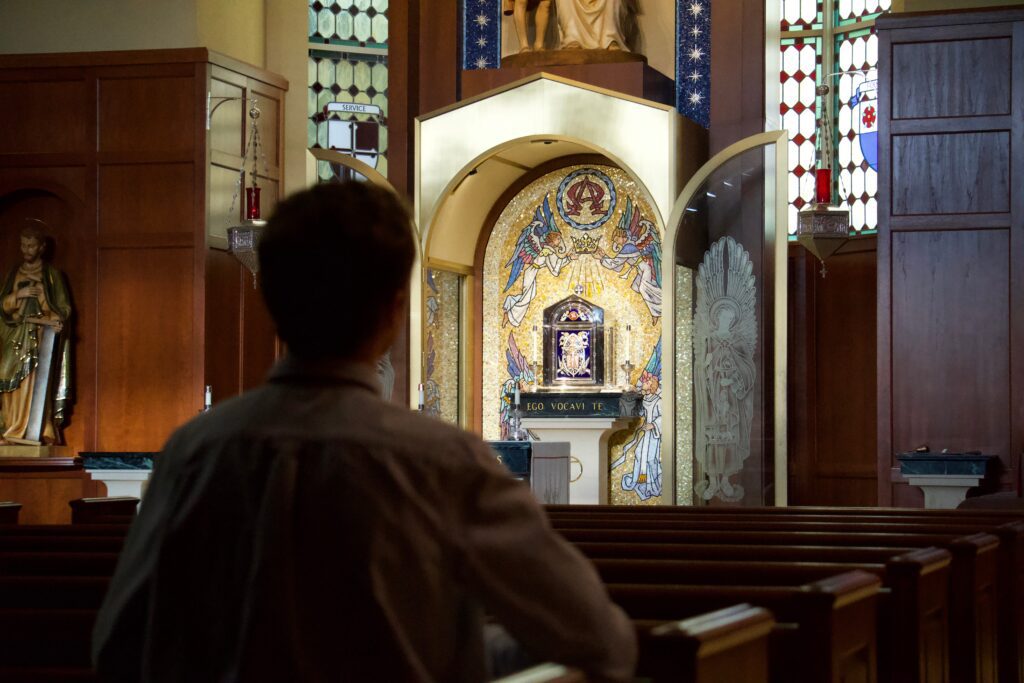
In a letter to parents, St. John Henry Newman, who at the time was the headmaster of an all-boys school in England, wrote: “boys take in religion principally through the eye.” Explain the faith by way of art and architecture. Use images to illustrate points.
Another way that you can make the faith tangible is by finding specific hands-on projects that boys will love. For example, every year at The Heights the eighth graders spend a week forging their own pocket crosses. They learn how to make a mold, how to melt metal, and then they do it themselves.
3. Charge your boys with defending the faith.

Boys love to playfight—both physically and intellectually. They love wrestling, tackle football, boxing, and debating. Rather than stifling these inborn tendencies, help your boys to direct them to virtuous ends.
You can do this by tasking your boys with the defense of the faith. Tell them that as men, their job is to be protectors, and that among the most important things they are called to protect is the truth, goodness, and beauty of their faith. This sort of framing will go a long way in motivating a boy to learn doctrine and to learn how to communicate well.
I will never forget my father at the beginning of high school banning me from punching anyone—that is, unless someone ever disrespected my mother or Our Lady. I am not necessarily recommending this to you, though the lesson was powerful for me as a young boy.
4. Marry action with contemplation.

Not only do boys enjoy rough-and-tumble play, they are also primed for movement. They run, climb, and jump. They love watching things that move—balls, cars, planes, trains. There are even strong neurobiological reasons for this.
At first glance, this proclivity to movement may seem to pose a challenge to getting boys to pray. It can, however, become an ally. In fact, Christ used it as an ally for calling some of his apostles. He calls them while they are in action, at work: fishing, tax collecting.
Here are two examples of ways to combine action with contemplation.
First, go on “contemplative walks” with your boys. This has become a standard practice for the lower school classes at The Heights. The process is simple. Spend ten minutes walking in silence. That’s it.
Second, prepare the mind and body for contemplative prayer through arduous physical activity. Perhaps you can end a long climb up a tall mountain with five minutes of silent meditation. That is what the fourth grade faculty do with their students after a day of strenuous hiking: a time of silence at the very top of one of the highest mountains in our area. The boys do it, and they love it.
5. Present the spiritual life as difficult—and worth the pain.

In What’s Wrong with the World, Chesterton writes, “The Christian ideal has not been tried and found wanting. It has been found difficult; and left untried.” This is certainly true. But it is also true that for many boys, the Christian ideal has been left untried because it was made to seem something soft and weak.
Many boys are actually attracted to doing difficult things. They like the challenge of accomplishing something that is hard. If you want to motivate a boy to do something, tell him that you don’t think he can do it; and he’ll want to prove you wrong.
In this context, a phrase often repeated by St. Josemaría comes to mind: esto vir—be a man.
These five suggestions are means to presenting the faith in a way that will resonate with young men. Ultimately, the most important way to do so is to surround them with good men, men with a deep faith, a love for life, and an even greater love for life’s author.
About the Author
Alvaro de Vicente
In addition to his responsibilities as headmaster of The Heights, Alvaro acts as a mentor to high schoolers and teaches senior Apologetics.