

Some books teach; some books entertain. The best books do both. That is why I enjoy Jane Austen. Each time I read her novels, I am inspired. Beneath her polished prose and sharp wit was an intelligent mind that perceived how easily we deceive ourselves. While she is known best for her female heroines, the men in her novels can serve as models for what a good man does and does not do. In this essay, I’ll concentrate on her novels from The Heights reading list (Pride and Prejudice, Emma, Persuasion, and Sense and Sensibility) and what the male characters there can teach us. My apologies in advance for any “spoilers.”
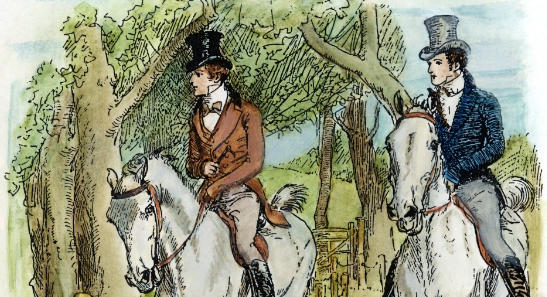
The first lesson is honesty. Good men are open and forthright. They do not play games or have secrets. Fitzwilliam Darcy in Pride and Prejudice is rich, handsome, and arrogant, but much of his apparent arrogance is really reserve, a compensation for his honesty and high moral standards. He states that “disguise of every sort is my abhorrence.” When he first proposes to Elizabeth he raises—to his detriment in the moment—the shortcomings of her family. Elizabeth is equally forthright in refusing him, citing his arrogance and seeming injurious behavior to others, most notably her sister Jane, whom Darcy had separated from his friend Bingley, and George Wickham to whom Darcy had refused an inheritance from Darcy’s father. Because Darcy prizes honesty, he is now prompted to “full disclosure.” It costs him. (Honesty often does.) He overcomes his pride and writes a letter to Elizabeth disclosing facts which are embarrassing to himself and his family. (N.B.: Truthfulness requires reflection, and writing a letter is often a good way to do this.) Wickham, by contrast, has played loose with the truth, and his deceptions will nearly ruin the Bennet family.
Honesty is also the outstanding trait of George Knightley in Emma. Candid to the point of bluntness, his rectitude is a driving force in the novel. Emma admires him for it but, because she is an “imaginist,” is also apprehensive of it. She is Austen’s most exasperating heroine: pretty, intelligent, and much too sure of herself. Knightley is the only person who sees her faults and is willing to tell them to her. He alone voices the harm that Emma does by her friendship with Harriet Smith, a nice but unconnected girl whom Emma has grand designs for. A turning point in the story comes when Emma mocks Miss Bates, a poor, elderly friend of theirs, and Knightley privately but forcibly chastises her. Because truth is his guide, he is able to discern what is actually going on with other characters in the novel, chiefly Frank Churchill, a gallant young man whom Emma fancies as a suitor. But Frank has not been open, and his game-playing hurts not only himself but several innocent other characters.
Frederick Wentworth in Persuasion is honest with others but not himself. Eight years before the opening of the novel, he had proposed to Anne Elliot, the heroine, but her family pressured her to refuse from his lack of rank and prospects at the time. Now a captain in the navy, he meets her again and realizes he still loves her, but he is distant almost out of spite. Anne seems set to marry William Elliot, a distant cousin. It is only when Wentworth learns this is not the case, and he overhears her describe the constancy of her affections, that he declares his love. He is a man of strong emotions but stronger reason. Like Darcy, he learns that honesty requires much humility.
In another novel, Sense and Sensibility, all three main male characters—Edward Ferrars, Colonel Brandon, and John Willoughby—are each hiding something. The first two from a sense of honor, the last from mercenary motives. Edward will retain his secrecy till circumstances allow him a free hand. Brandon will reveal his past when he realizes it will help others. Willoughby gets caught in his own trap, to his shame and regret.
Darcy, Wentworth, and Knightley share another trait: they accept and handle responsibility. Darcy takes responsibility for his sister Georgiana after their father dies. She looks up to him “almost as a second father.” It is his concern for her that holds back his disclosure of what he knows of Wickham. Both he and Knightley are conscientious landlord farmers. And Wentworth, by age thirty, has commanded ships in battle and earned a fortune the hard way. Whatever these men have received from others they see as a trust, and they live up to it.
Austen’s counterexamples underscore the theme. Elizabeth’s father, Mr. Bennet, is an amiable man but married Mrs. Bennet for her looks, and her vacuity causes trouble throughout their marriage. While his eldest daughters Jane and Elizabeth are sensible enough, his lack of concern for the younger ones, Mary, Kitty, and Lydia, allow them to become, in turn, prudish, slothful, and flirtatious. He will pay the price. Wickham is smooth but selfish. You may invite him to your party, but you wouldn’t trust him to take care of your dog. Anne Elliot’s father, Sir Walter Elliot, is vain and entitled. His irresponsibility forces their family to leave their ancestral home for the city of Bath, where he will be a sycophant. Her cousin William Elliot has squandered his fortune and now is a fortune hunter. Frank Churchill has never been responsible, and the reader wonders if even the love of a good woman can save him. This distinction holds true in Austen’s other novels as well, where the combination of idleness and money always spell trouble. Responsibility is a quiet, almost unnoticeable quality, but vital. It is a sine qua non of good character.
Good men are concerned for family, friends, and others. Elizabeth faults Darcy for separating Bingley from Jane, but Darcy did it out of sincere concern for Bingley. Darcy’s housekeeper tells Elizabeth that he was respectful as a child and kind to the servants. When Wentworth meets the mother of a sailor who fell under his command, he listens to her and consoles her. He will make time to visit an old friend and fellow officer, now discharged because of wounds and living on a pension. It is one of the most touching scenes in the novel. Knightley shows great respect to Emma’s father, though he is a tiresome valetudinarian. Miss Bates is a world-class chatterbox, but Knightley doesn’t seem to mind, and aware of her indigence and age, unobtrusively sends her food and arranges rides for her. He advises Robert Martin, one of his tenants, on marriage, consoles him when he is refused, and then works discreetly to bring about the match. Above all, he puts up with Emma. His honesty with her is but a reflection of his concern and love for her, as real honesty should be.
Good men admit their faults and mistakes and do something about them. Elizabeth’s rejection makes Darcy, for perhaps the first time in his life, confront himself. He has excused his reserve before as just not having the “talent” to make himself agreeable to others. But Elizabeth sardonically calls him out when she says of her lack of skill at the piano, “But then I have always supposed it to be my own fault—from not having taken the trouble of practising (sic).” Some months later, Darcy and Elizabeth meet again at his estate in company with Elizabeth’s uncle and aunt, and Darcy is now amiable and attentive. When he learns that Wickham has eloped with Lydia, he blames himself for not having disclosed what he knew about Wickham. Unbeknownst to Elizabeth, and with great cost, trouble, and humiliation, he arranges the proper marriage of Lydia. He will also apologize to Bingley and encourage him to pursue Jane again. When Wentworth learns that his actions have given rise to false expectations regarding another young lady, he immediately departs to quell the rumors. When he realizes that he has been mistaken about Anne, he humbles himself. Knightley will recognize that his dislike of Frank Churchill stemmed in part from envy over Emma’s good opinion of him. Later, Knightley will even learn to see some good in Frank Churchill
Manners are good and necessary, but they should be an extenuation of, not a cover for, character. It is what you do when no one is looking that shows who you really are, and silence can speak volumes. Elizabeth will realize this about Darcy when she reflects that much of what he has said to her about her family is true, but he has said it to no one else. And he does things rather than just talking about them. Wentworth will not bring up the past to Anne or her family in light of his current fortune, though in many ways he has a right to. Knightley’s forbearance and attentiveness are almost unnoticed because that is how true courtesy works. A key to Austen’s novels is to regard what characters do over what they say, and to realize that those who talk the most usually know the least.
Austen’s novels are centered on love and marriage, and the better the men, the better the marriages are. “Falling in love” is a tricky business, and men and women—much less boys and girls—are rarely on the same page. People can be seriously hurt, and dire consequences can follow when we aren’t careful. Love is based on respect, which in turn is based on honesty. A good husband is responsible. He is concerned for others more than himself, and that concern is manifested by quiet attentiveness. If role models are needed, Jane Austen is a good place to start.
Recommended reading:
The Prayers of Jane Austen by Jane Austen