

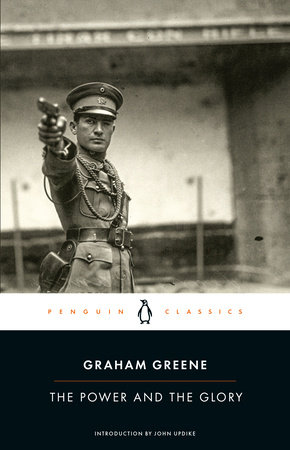

Have you ever read a book that inspired in you a soul-crushing desire to eat fried chicken, shed undefinable tears through a mouthful of Sprite, and slap someone in the face with a tortilla? My students and I found ourselves in this conflicted state after taking the long hard journey through the jungle of Graham Greene’s The Power and the Glory.
The story starts in a hot dusty village where a lethargic dentist meets an alcoholic priest who is on the run from the deadly zeal of a hostile lieutenant. We follow this unnamed priest through a mostly unnamed land at a mostly unspecified time. This vagueness, unlike the vagueness of some English essays I am obligated to endure, is deliberate and effective. We don’t exactly know where we are, so we could be anywhere. We don’t know exactly when we are, so we could be any time. We don’t exactly know who we are, so we could be anyone. We certainly could be any one of the characters in the novel, and therein lies the challenge of this book. It shows us people struggling to define their beliefs. For some of them, memories and photographs of liturgy and parish life repulse rather than encourage faith. Some characters settle on faith in human-imposed social order, some on faith in saccharine stories, some on bland and mechanical adherence to proverbs, some despair. Like Jacob in the night, all of them wrestle in the darkness with an angel named Christianity, most specifically Roman Catholicism.
Blatantly or subtly, these people are sinners, notably the protagonist, referred to only as “the whiskey priest” because of his desperate abuse of alcohol. Lest we incline toward simple commiseration with him on the grounds that the helplessness accompanying addiction ameliorates the offense, we are confronted with the fact that he has fathered a child, violating his priestly vows and causing scandal as he continues to celebrate Mass and administer the sacraments. The priest even seems to oscillate between repenting his action and defending it. As in real life, sin is relentless. At every turn we come upon new characters, seemingly overcome by despair, snobbery, fornication, betrayal, murder, resentment, or remorselessness.
By a route circuitous as that of the nameless protagonist, we stumble back to the hot dusty village where we started. But something has changed along the way. The young boy previously unmoved by the saccharine saint stories is now unmoved by secular zealous dictatorship. The ultimate sacrifice is given to allow sacramental grace into the lives of others. What happened?
Truth is every bit as strange as fiction. The truth here was that in the middle of all this chaos and confusion we had encountered hope. It may have been just a flickering candle flame, standing fragile against the blustering protestations of the sanctimonious, the sighs of those settling for the immediate, or the shouts of the benevolent but misguided tyrant. But a candle shows up better in the darkness. It may seem smaller, but it is also clearer. We simply have to look for it. In this essential novel, seeing the good in others in spite of their faults is seeing the candle, and Greene is challenging us to look closely. In Evelyn Waugh’s comparable journey, Brideshead Revisited, the little red lamp is literally still burning even though the world around it is being dismantled. In The Power and the Glory, there is no literal lamp, but faith is kindled in one heart even when life dies out in another. The Calvaric discovery that the fire can’t die brings exultation.
I’ve seen readers turn away from this book in disgust or distaste, or out of a sense of moral indignation. So I think it will be worth articulating the sense behind those reactions and offering some response.
A sense of disgust is justified. Much of the imagery is repellent at first, and is meant to be so. You may ask, why is repellent imagery necessary? It isn’t for every book. But we have to have a few great books that do it, not gratuitously, but to illuminate. Are we only going to read books in which death, decay, and defecation don’t exist? If so, how can literature really hold the mirror up to nature? How will we be able to look at ourselves the way we really are? We can ask whether these things have to be shown in order for us to see our lives. The answer is that it is good, sometimes, to see hope in action. Hope only happens in the darkness, and if the darkness isn’t there, a depiction of hope is false, or at least inept.
Objections to the book on moral grounds seem to take one of three forms: 1) it is bad because of the immoral life of the author, 2) it is objectionable because it portrays bad morals, or 3) it has a bad message. The first of these is ridiculous, assuming any art is worth looking at, reading, or listening to. Should we boycott any artist who lives in a sinful way? Boycott Rodin’s “Hand of God” because he had a mistress? Tolstoy’s War and Peace because of his unorthodox theology? Caravaggio, Wagner? Is the movie Becket evil because of Richard Burton? Are Passion of the Christ or Romeo and Juliet to be spurned because of Gibson’s and Zeffirelli’s transgressions? Oddly enough, if you believe that personal sin is grounds for rejecting someone’s words, you’re going to have to reject your own opinions. This would hobble creativity and make symposium impossible.
The “book portrays bad morals” idea is more complex. Sometimes this objection is based on a surface read rather than a deeper one. In this story, things can appear backwards on the surface, including the following: a romance novel cover disguises a missal, there is an implied criticism of parents reading lives of the saints to their children, and suggestions that both casual and desperate fornication are either beautiful or acceptable. But these examples are exactly the challenge the book intends to present to us: a challenge to look below the surface. The boy rebels against a particular version of a saint story because it depicts an impossible sanctity in a martyred priest, but his heart swells with admiration when real martyrdom happens before his eyes. For another example, it might seem that the most important thing for the priest to do is go to confession and restore God’s life to his soul, and he consistently turns away opportunities to do so. But the moral dilemma is that the only way for him to go to confession would be for him to abandon the people in his spiritual care. He’d have to run across the border, because apart from the apostate Padre Jose, who refuses to see him, he is the only priest left. He is their only source of the grace of the sacraments. Our challenge is not to solve the dilemma, but to feel and acknowledge it, feel the anguish of his soul and theirs.
The book portrays immoral actions, certainly, but depiction does not constitute approbation. How do we tell the difference? Well, for starters, none of the behavior depicted in the book is unreal, nor is it glamorized, and as the novel itself points out, sanitized and candified literature can actually turn people away from what is inherently good. Perhaps human beings who are still innocent don’t need to read something like this book, but it’s a beneficial experience for those of us who are past the innocent phase.
The third version of the “bad morals” objection depends on the idea that books are necessarily messages, or explanations of the abstract. But the best fiction isn’t message or explanation; it’s a vicarious experience, unexplained, intimate, and intermingling understanding and confusion, vice and virtue, grief and joy, just like our own lives. The value is in the vicarious; we can see and consider the experience without the immediate urgency of living it.
So where are the Sprite and fried chicken in all this mess? In The Power and the Glory we can find putrid scraps on a bone and tepid gaseosa, but no such comforting comestibles as described at the top of this page. Yet in class, our exultation at the end led to the idea that we should have a celebratory feast using only foods (or in the case of the whiskey, an analogous substitute) from the book. The bone with a hanging scrap of meat became scrumptious fried chicken, the gaseosa was Sprite, the whiskey was apple cider in paper shot glasses, the tortillas and sugar cubes were… tortillas and sugar cubes. We ended with the tortilla slap game, in which two parties face each other with a mouthful of Sprite and slap each other with a tortilla until someone laughs the soda all over the place. The tortillas were wielded to great effect, the soda went off in all directions, and exuberance abounded. When you’ve gone through the dark days of Calvary, the Resurrection is all the more joyful.